Categories
Digital Signages

Cloud vs On-Premise Digital Signage: Which Is Better in 2026?

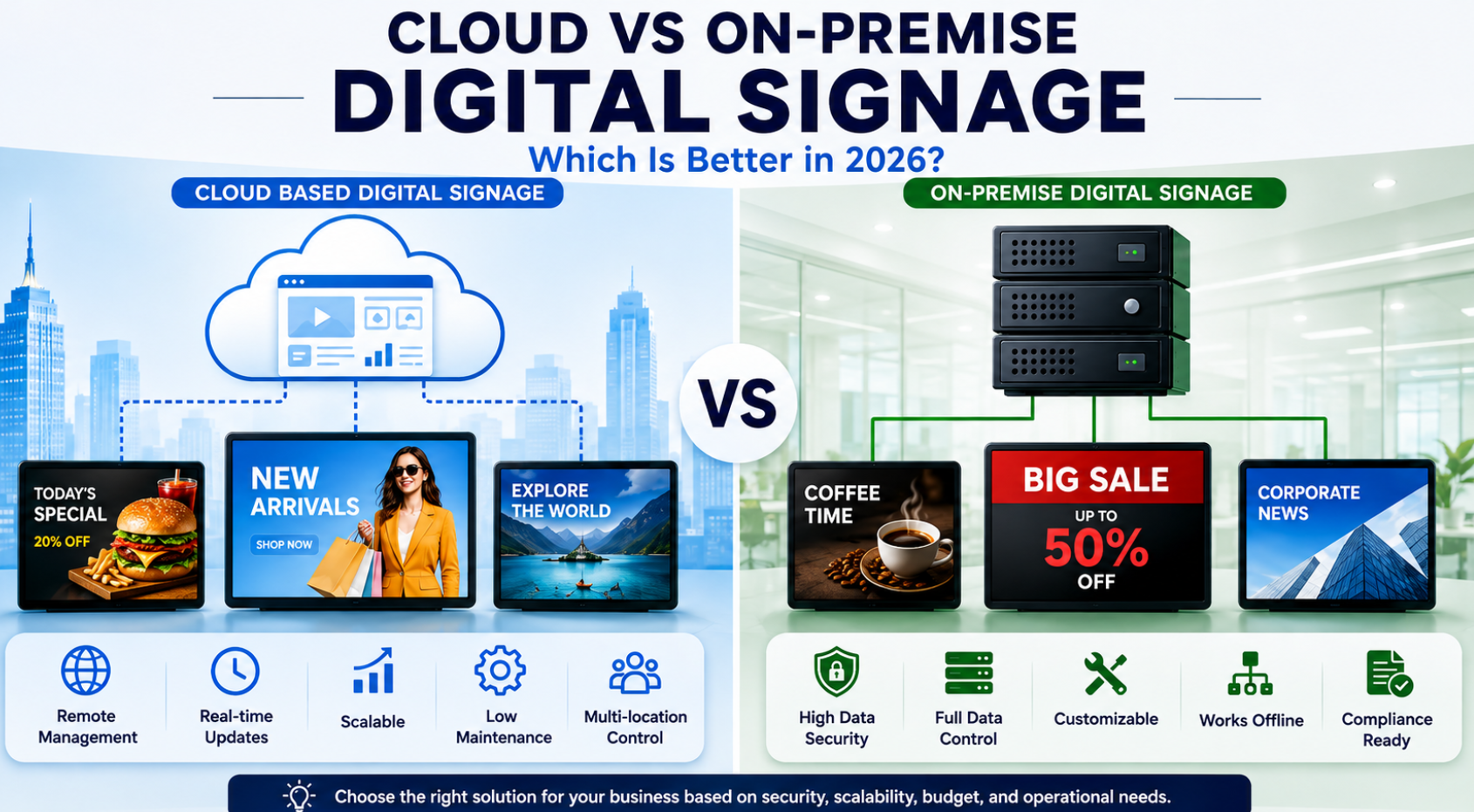
Cloud vs On-Premise Digital Signage

Digital signage has evolved from simple display screens into intelligent communication platforms that help businesses engage customers, manage operations, and improve brand consistency. But before investing in a digital signage system, one question often comes up:

Should you choose cloud based digital signage or an on-premise solution?

The answer depends on your business size, security requirements, number of locations, IT resources, and growth plans.

In this guide, we'll compare cloud based digital signage with on-premise digital signage across cost, security, scalability, maintenance, and performance to help you make the right decision in 2026.

What is Cloud Based Digital Signage?

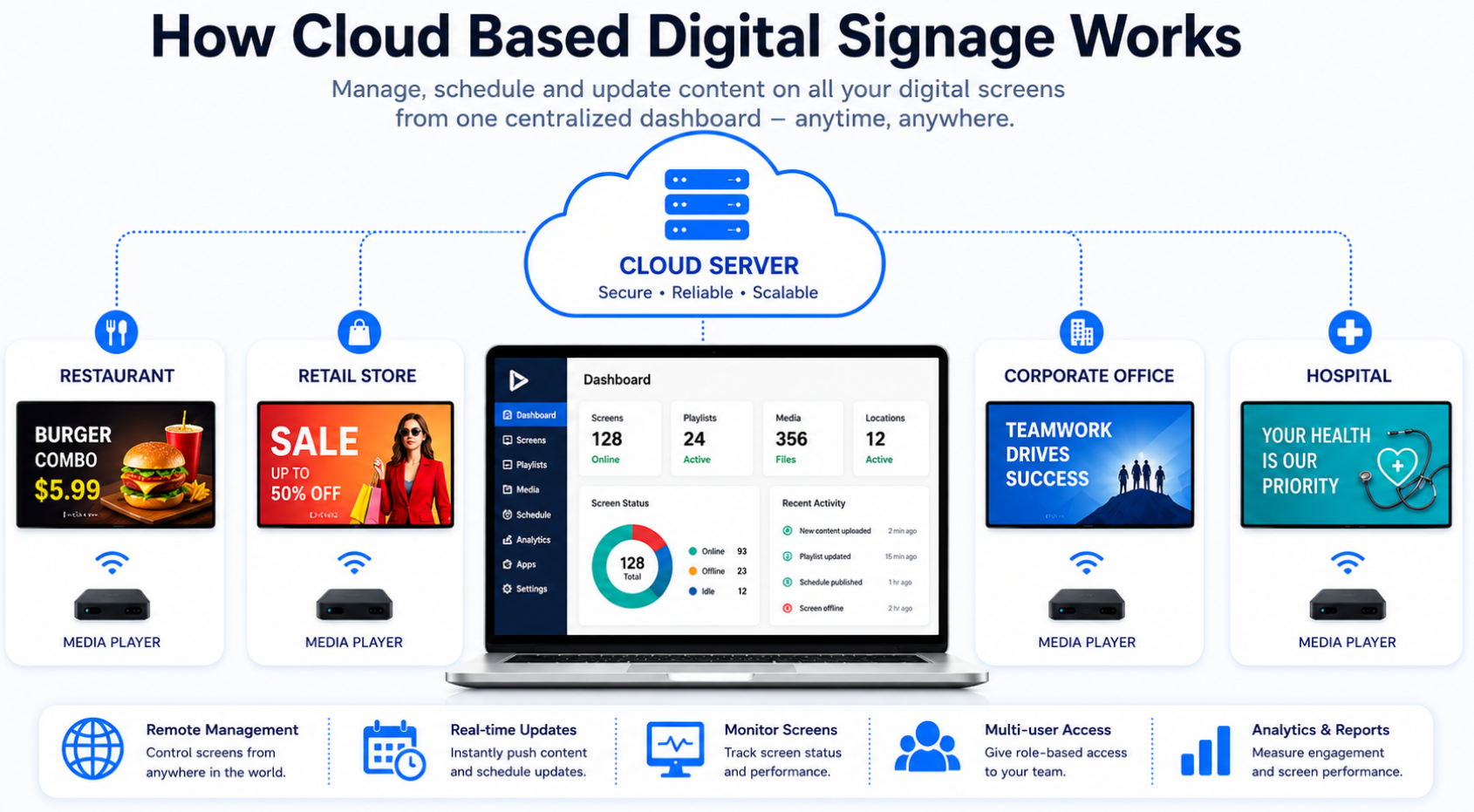
Cloud based digital signage is a solution where all content, scheduling, user management, and device monitoring happen through the cloud.

Instead of installing software on local servers, you simply log into a web dashboard from anywhere and manage all your digital screens remotely.

Whether you have one retail store or hundreds of branches across India, updates can be published instantly without visiting each location.

Typical features include:

  • Remote content management
  • Centralized scheduling
  • Real-time monitoring
  • Automatic software updates
  • Multi-user access
  • Analytics and reporting
  • Easy scaling across locations
Cloud vs On-Premise Digital Signage

Modern Digital Signage Solutions increasingly rely on cloud infrastructure because of the flexibility and convenience it offers.
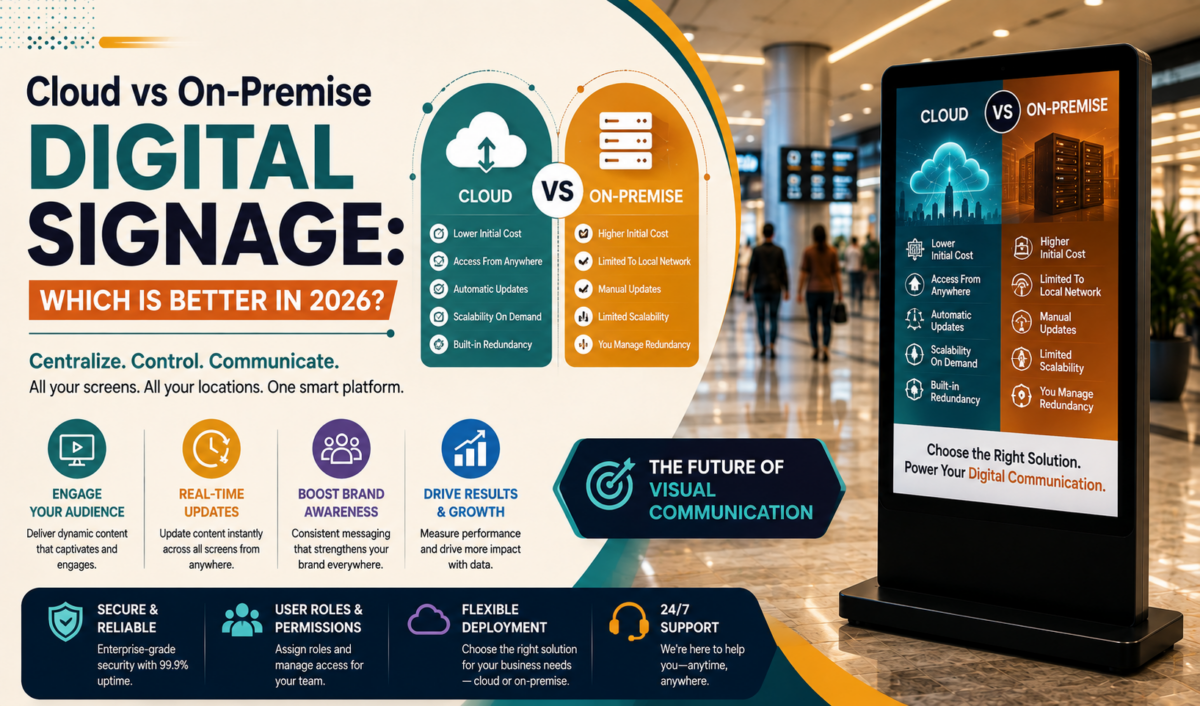
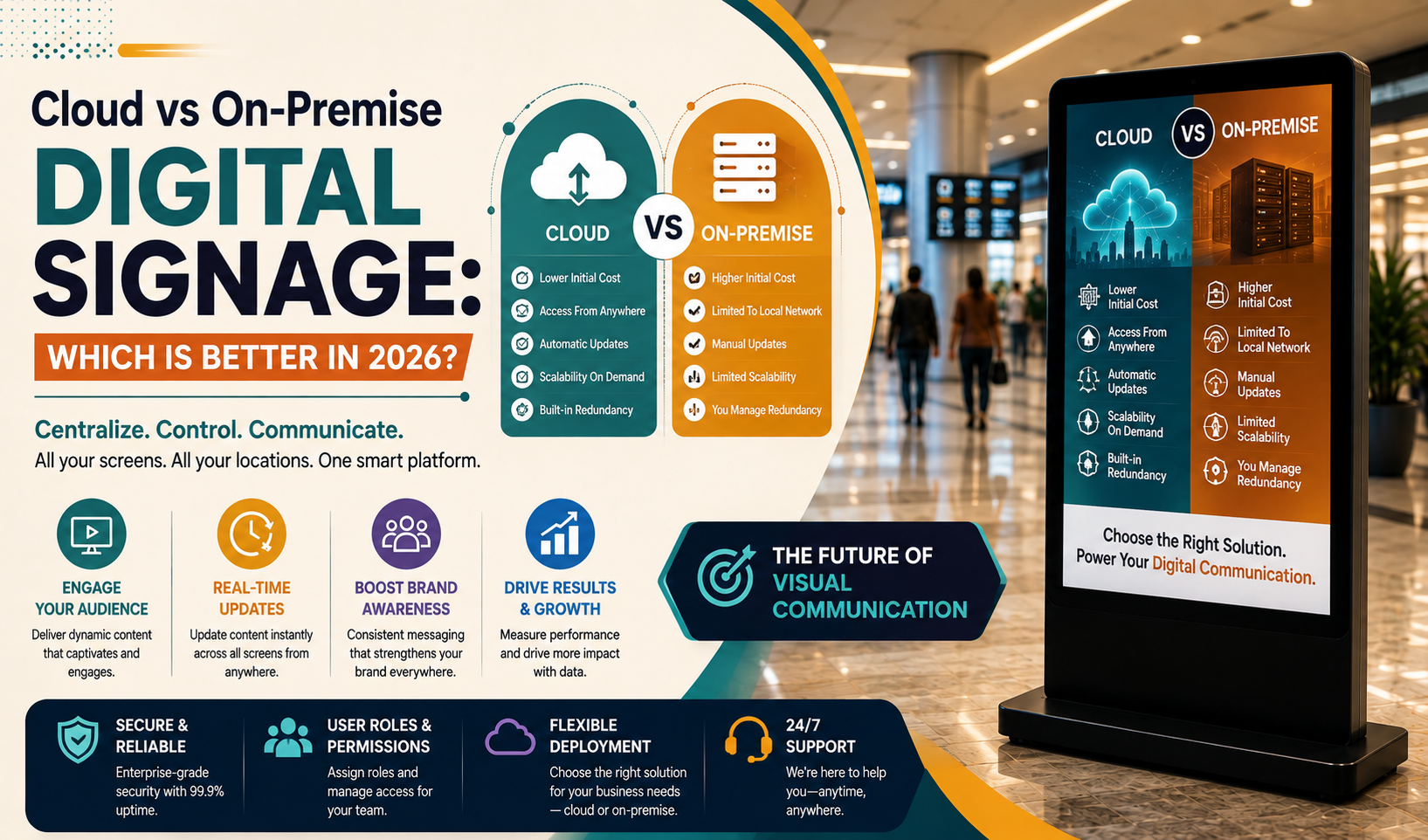
Cloud vs On-Premise Digital Signage by Intelisa

What is On-Premise Digital Signage?

An on-premise digital signage solution stores all software, media, and management systems on servers within your organization.

Everything, from content management to user access, is hosted on your own infrastructure.

Businesses usually choose this model when they have strict compliance requirements or need complete control over their network.

Common characteristics include:

  • Local servers
  • Internal network management
  • Offline content hosting
  • Dedicated IT administration
  • Greater infrastructure ownership

Industries like defence, manufacturing, healthcare, and government sometimes prefer on-premise deployments where internet connectivity or regulatory requirements limit cloud adoption.
Intelisa Blog

Cloud vs On-Premise Digital Signage

FeatureCloud Based Digital SignageOn-Premise Digital Signage
DeploymentQuickLonger setup
Remote AccessAnywhereUsually VPN or local network
Initial InvestmentLowerHigher
MaintenanceVendor managedInternal IT team
Software UpdatesAutomaticManual
ScalabilityExcellentRequires new infrastructure
Multi-location SupportVery easyComplex
Internet DependencyYesMinimal
CustomizationModerateHigh
Data ControlVendor + CloudComplete internal control

Cost Comparison

Cost is one of the biggest deciding factors when choosing between cloud and on-premise digital signage.

Cloud Based Digital Signage

The cloud model typically follows a subscription-based pricing structure.

You pay monthly or annually depending on:

  • Number of screens
  • Storage
  • Features
  • Users
  • Support plan

Since there are no servers to purchase or maintain, the upfront investment remains relatively low.

Additional benefits include:

  • No server hardware costs
  • Reduced IT staffing
  • Automatic upgrades
  • Predictable operating expenses

For growing businesses, this often results in a lower total cost of ownership.
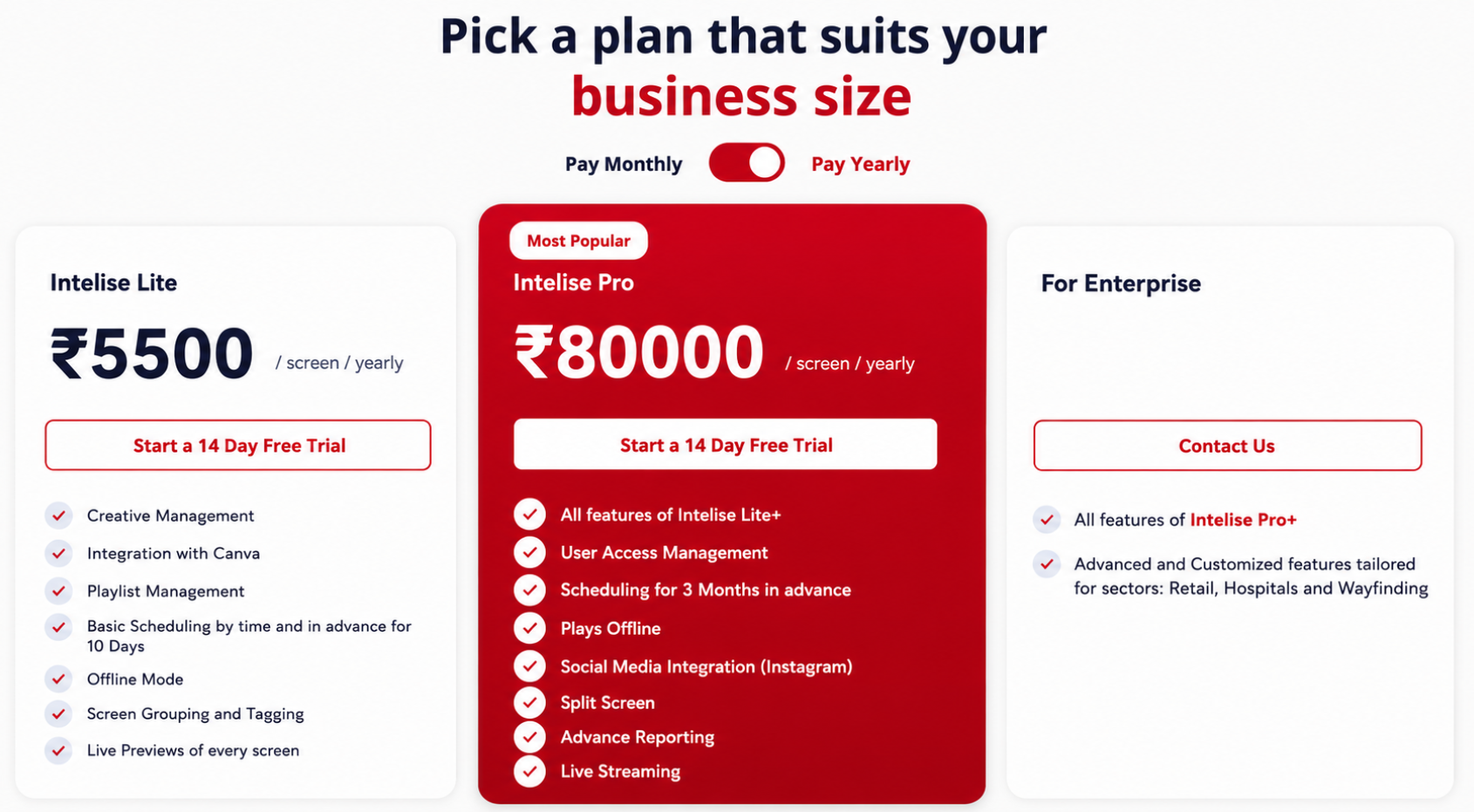
💰 For a complete picture check: Digital Signage Software Pricing in India by Intelisa
Digital Signage Software Pricing in India by Intelisa

On-Premise Digital Signage

On-premise solutions involve higher upfront expenses.

These may include:

  • Server infrastructure
  • Software licenses
  • Networking equipment
  • Backup systems
  • Security infrastructure
  • IT personnel

Although recurring subscription fees may be lower, maintenance, upgrades, and hardware replacements can significantly increase long-term costs.

Security Comparison

Security concerns often influence the final decision.

Cloud Based Digital Signage

Modern cloud providers invest heavily in security features such as:

  • End-to-end encryption
  • Multi-factor authentication
  • Role-based permissions
  • Automatic backups
  • Disaster recovery
  • Regular security patches

For many businesses, cloud platforms actually offer stronger security than self-managed systems because updates happen continuously.

On-Premise Digital Signage

On-premise solutions provide complete ownership of infrastructure and data.

Organizations can:

  • Define their own security policies
  • Restrict internet access
  • Keep data within internal networks
  • Meet specialized compliance requirements

However, maintaining security depends entirely on the organization's IT capabilities.

Without regular updates and monitoring, on-premise systems can become vulnerable over time.

Also Read: Digital Display Screens: Types, Tech and Business Uses

Scalability

As businesses expand, signage infrastructure should grow with them.

Cloud

Adding new digital displays is simple.

Typically, you only need to:

  • Connect a new media player
  • Register the device
  • Assign content
  • Start publishing

The same dashboard can manage hundreds or even thousands of screens.

On-Premise

Scaling usually requires:

  • Additional servers
  • Network upgrades
  • Storage expansion
  • IT configuration

This makes rapid expansion slower and more expensive.

Businesses planning multiple branches often prefer cloud based digital signage because scaling is much simpler.

Ease of Management

Cloud platforms are designed for centralized operations.

Managers can:

  • Schedule campaigns remotely
  • Monitor screen health
  • Push emergency announcements
  • Update promotions instantly

Everything happens from one dashboard.

With on-premise systems, administration often depends on local infrastructure, making large deployments harder to manage efficiently.

Reliability

Many businesses assume on-premise systems are always more reliable.

In reality, reliability depends on system design.

Cloud-based digital signage platforms usually continue displaying downloaded content even if the internet temporarily disconnects. Once the connection returns, updates sync automatically.

On-premise systems work well in environments with reliable local infrastructure but require regular backups and server maintenance to minimize downtime.

Which Businesses Benefit Most?

Choose Cloud Based Digital Signage if you have:

  • Retail chains
  • Restaurants
  • Banks
  • Educational institutions
  • Hospitals
  • Hotels
  • Corporate offices
  • Franchises
  • Multi-location businesses

Cloud platforms simplify content management across distributed locations and reduce the need for on-site technical support.

Choose On-Premise Digital Signage if you have:

  • Highly regulated industries
  • Defence organizations
  • Sensitive government departments
  • Facilities with limited internet access
  • Organizations requiring complete infrastructure ownership

Cloud Digital Signage in India

The demand for digital signage India continues to grow as businesses adopt smarter customer communication systems.

Retailers, malls, airports, hospitals, and corporate offices increasingly prefer cloud-based deployments because they allow teams to manage digital display screens across cities from a single platform.

For businesses operating across multiple states, cloud solutions eliminate the complexity of updating each location manually, helping ensure consistent messaging and faster campaign rollouts.

Which One Should You Choose?

For most businesses in 2026, cloud based digital signage is the better choice.

It offers:

  • Lower upfront investment
  • Faster deployment
  • Remote management
  • Easier scaling
  • Automatic software updates
  • Reduced maintenance
  • Better collaboration across teams

However, on-premise digital signage remains a strong option for organizations with strict compliance requirements, highly sensitive data, or isolated networks.

Ultimately, the right solution depends on your operational needs, IT resources, and long-term growth strategy.

Conclusion

The future of digital signage is increasingly cloud-driven. As businesses expand across locations and demand faster, more efficient content management, cloud platforms provide the flexibility, scalability, and ease of use that modern operations require.

At Intelisa, our cloud-powered digital signage solutions make it easy to manage digital screens from anywhere through a centralized dashboard. Whether you're running a single outlet or a nationwide network, you can update content instantly, schedule campaigns, monitor screen performance in real time, and scale effortlessly as your business grows.

Want to see how it helps? Book a free trial today!

Frequently Asked Questions

Is cloud based digital signage secure?

Yes. Most modern cloud platforms use encryption, role-based access control, automatic backups, and regular security updates to protect business data.

Does cloud digital signage require an internet connection all the time?

No. Most solutions cache content locally, so screens continue playing scheduled content even during temporary internet outages.

Is cloud digital signage cheaper than on-premise?

Generally, yes. Cloud solutions have lower upfront costs and reduce expenses related to server maintenance, upgrades, and IT infrastructure.

Which industries benefit the most from cloud digital signage?

Retail, restaurants, healthcare, education, hospitality, banking, corporate offices, and franchise businesses benefit the most due to centralized management and easy scalability.

Can cloud digital signage manage multiple locations?

Absolutely. One of the biggest advantages of cloud based digital signage is the ability to control hundreds or even thousands of digital displays across different locations from a single dashboard.

See Cloud Digital Signage in Action

Manage every screen from a single dashboard, update content instantly, and scale effortlessly with Intelisa.

Book a Free Trial
Categories
Digital Signages

Touchscreen & Sensor-Based Interactive Display Guide

Touchscreen & Sensor-Based Interactive Display Guide

Every touchscreen feels the same to the person using it, but underneath the glass, very different sensing technology decides how it responds. Choosing the right touch or sensor technology, not just the right screen size, is what determines whether an interactive display feels instant or frustrating.

Businesses often shop for an interactive display by screen size and resolution first, and treat the touch layer as an afterthought. That is a mistake. The sensing technology underneath the panel affects accuracy, durability, and even who can use the screen, whether that is a bare finger, a gloved hand, or a stylus. It is a layer that sits on top of the broader display technologies a business chooses from.

$59.83B Global interactive display market size in 2026
$125.48B Projected market size by 2034, at a 9.70% CAGR
68% Share of the market held by capacitive touch technology

Both figures come from Fortune Business Insights, and the dominance of capacitive touch reflects why it has become the default choice across retail, corporate, and education deployments, though it is not the right fit for every environment.

How Touch Sensing Actually Works

A touchscreen is not one piece of technology, it is a sensing layer paired with a display. The sensing layer detects where and how a surface is touched, then passes that coordinate to the software running the display. Different sensing methods trade off cost, accuracy, durability, and what kind of input they can detect.

Types of Touch and Sensor Technology

Most Common

Capacitive (PCAP)

Detects the electrical charge from a bare finger, supports multi-touch, and offers a fast, smartphone-like response. Does not reliably work with gloves or a passive stylus.

Best for: retail, kiosks, education

Rugged

Infrared (IR)

Uses a grid of infrared beams around the screen edge to detect interruption from any object, including gloves or a stylus. Very durable but less precise for fine detail.

Best for: outdoor kiosks, industrial use

Budget

Resistive

Responds to physical pressure through two flexible layers, so it works with gloves, styluses, or fingernails. Less accurate and does not support true multi-touch.

Best for: point-of-sale, basic terminals

Precision

Surface Acoustic Wave (SAW)

Uses ultrasonic waves across the glass surface to detect touch, offering high image clarity since nothing overlays the screen. Sensitive to surface contamination like dust or liquid.

Best for: clean indoor environments

Contactless

Proximity & Gesture Sensors

Detects motion or hand position near the screen without physical contact, using infrared or optical sensors, useful where hygiene or accessibility matters.

Best for: healthcare, public terminals

Precision Input

Optical Imaging

Uses cameras at the screen corners to triangulate a touch point, scaling well to very large display sizes without losing accuracy, which is why it pairs well with large-format video walls.

Best for: large-format interactive walls

Where Touch Technology Choice Actually Matters

Outdoor and Semi-Outdoor Installations

Dust, rain, temperature swings, and users wearing gloves all rule out delicate sensing methods. Infrared touch is generally the more reliable choice here because it keeps working regardless of what is touching the screen.

High-Traffic Public Terminals

Screens used by hundreds of people a day, such as retail kiosks or check-in terminals, need a sensing layer that stays accurate under constant use. Capacitive touch is the standard here because it responds quickly and supports the swipe and pinch gestures people already expect from their phones.

Healthcare and Hygiene-Sensitive Spaces

In clinics and hospitals, a screen that many hands touch throughout the day raises hygiene concerns. Proximity and gesture sensing, or antimicrobial capacitive surfaces, reduce direct contact while still giving users control, an important consideration for the self-service and information kiosks increasingly deployed in these spaces.

The right touch technology is not the most advanced one, it is the one that matches how, where, and by whom the screen will actually be touched.

Choosing the Right Technology: A Quick Checklist

1

Define the Environment

Indoor, outdoor, dusty, humid, or climate-controlled conditions all narrow down which sensing technology will hold up over time.

2

Identify Who Will Touch It

Bare fingers, gloved hands, a stylus, or contactless gestures each favor a different sensing method, so match the technology to the actual users.

3

Decide if Multi-Touch Is Necessary

Applications like wayfinding maps or collaborative boards benefit from true multi-touch, while a simple menu selector may not need it at all.

4

Account for Expected Traffic

High-traffic public screens need a sensing surface rated for constant daily use, not a technology designed for occasional interaction.

5

Factor in Total Cost of Ownership

A cheaper resistive panel that needs frequent recalibration or replacement can cost more over time than a durable capacitive or infrared panel.

Run Any Touch Technology on One Platform

Intelisa's cloud-based platform runs interactive content on any touchscreen or sensor-based display, whatever the underlying touch technology, and keeps every screen updated and monitored from one dashboard.

  • Compatible with capacitive, infrared, and resistive touch panels
  • Update interactive content across every screen instantly
  • Monitor touch response and device health remotely
  • Scales from a single display to a full deployment
Book a Free Trial
Intelisa touchscreen interactive display

Frequently Asked Questions

What is the difference between capacitive and infrared touch?

Capacitive touch detects the electrical charge of a bare finger and offers a fast, smartphone-like response, but does not reliably work with gloves. Infrared touch uses a grid of light beams to detect interruption from any object, including gloves or a stylus, making it more durable for rugged or outdoor use.

Which touch technology works best outdoors?

Infrared touch technology is generally the most reliable choice for outdoor or semi-outdoor installations, since it continues to respond accurately in dust, moisture, and temperature swings that can affect other sensing methods.

What is a sensor-based interactive display?

A sensor-based interactive display uses proximity, gesture, or optical sensors to detect a user's presence or motion near the screen, allowing interaction without direct physical contact, which is useful in healthcare and other hygiene-sensitive environments.

Does touch technology affect multi-touch support?

Yes. Capacitive touch reliably supports true multi-touch gestures like pinch and swipe with multiple simultaneous points of contact, while resistive touch technology generally does not support multi-touch in the same way.

Why is capacitive touch the most common technology?

Capacitive touch holds roughly 68% of the interactive display market because it delivers a fast, accurate, multi-touch response that feels familiar to users already accustomed to smartphones and tablets, making it the default choice for retail, kiosks, and education.

Is the interactive display market growing?

Yes. The global interactive display market was valued at approximately $59.83 billion in 2026 and is projected to reach $125.48 billion by 2034, growing at a 9.70% CAGR, driven by adoption across retail, education, corporate, and healthcare environments.

Final Takeaway

The sensing technology behind a touchscreen determines how it will actually perform once it is installed, and that choice matters more than screen size or brand. Matching the technology to the environment, the users, and the expected traffic prevents a display from becoming unreliable within months of deployment.

Deploy the Right Touch Technology for Your Space

Intelisa runs interactive content across any touchscreen or sensor-based display, and keeps every screen managed and monitored from one dashboard.

Book a Free Trial
Categories
Digital Signages

Interactive Wayfinding For Modernizing Malls, Airports, and Hospitals

Interactive Wayfinding For Modernizing Malls, Airports, and Hospitals

Large public spaces confuse people. A mall with 300 stores, an airport with a dozen gates, or a hospital with twelve floors is hard to navigate on foot, and static maps rarely help. Interactive wayfinding replaces that guesswork with a touchscreen that gives people a route in seconds.

Every large facility has the same problem: people spend time being lost instead of shopping, boarding, or getting treated. That lost time hurts the visitor experience and, in commercial spaces, it hurts revenue too. Interactive wayfinding kiosks are becoming the standard answer, and adoption is accelerating fast across malls, airports, and hospitals.

A wayfinding kiosk is one specific application of the broader interactive kiosk category, built specifically around navigation rather than ordering, ticketing, or payments.

$3.42B Global interactive wayfinding solutions market size in 2026
$13.08B Projected market size by 2035, at a 16.1% CAGR
70%+ Of large malls had adopted interactive wayfinding kiosks by 2024

These numbers, reported by Business Research Insights, reflect a simple shift: static directories and printed maps are being replaced by digital, touch-driven navigation across the built environment.

What Is Interactive Wayfinding?

Interactive wayfinding is a digital navigation system, usually delivered through a touchscreen kiosk or a large interactive display, that helps people find a specific location inside a building or campus. Instead of scanning a printed directory, a visitor searches for a store, gate, or department, and the screen shows a highlighted route on a live map.

Most modern systems combine three things: an interactive map, a search or directory function, and a way to generate turn-by-turn directions, sometimes with a QR code that sends the same route to the visitor's phone so they are not tied to the kiosk.

Why Malls, Airports, and Hospitals Need It

Malls

A large mall can have hundreds of stores across multiple floors, and layouts change constantly as tenants move in and out. A printed directory goes out of date the moment a store relocates, while a digital wayfinding kiosk can be updated centrally in minutes. It can also promote current offers along the way, turning a simple direction lookup into a chance to highlight a sale the visitor might otherwise miss, an extension of how digital signage is already transforming the shopping mall experience.

Airports

Airports are high-stress, time-sensitive environments where a missed gate has real consequences. Interactive wayfinding at terminals helps passengers locate gates, lounges, baggage claim, and amenities quickly, and can factor in real-time flight information so directions stay accurate even when a gate changes at the last minute.

Hospitals

Hospitals are some of the most difficult buildings to navigate, with multiple wings, floors, and departments that all look alike to a first-time visitor. For patients and families who are often already stressed, getting lost adds unnecessary anxiety. A wayfinding kiosk at the entrance or on each floor can direct visitors to the right department, reducing the load on reception staff who would otherwise be giving directions all day. This fits into the wider role digital signage plays across healthcare facilities, from wayfinding to queue and patient information.

A wayfinding kiosk does more than point people in the right direction. It removes a source of frustration at exactly the moment a visitor is forming an impression of the space, whether that is a mall, a terminal, or a hospital ward.

Key Benefits of Interactive Wayfinding

Navigation

Faster, Accurate Routes

Visitors get a live, searchable map instead of a static directory that may already be outdated.

Staff Load

Fewer Direction Requests

Front desk and information staff spend less time repeating directions and more time on higher-value tasks.

Engagement

On-Screen Promotions

Malls and retail spaces can surface offers and store highlights along a visitor's route.

Accessibility

Easier for Everyone

Large text, multiple languages, and QR handoff to mobile make wayfinding usable for a wider range of visitors.

Data

Visitor Insights

Search terms and popular routes reveal what people are actually looking for in the space.

Brand

A Modern First Impression

A clean, responsive kiosk signals a well-run, technology-forward facility from the moment someone walks in.

Best Practices for Deploying Wayfinding Kiosks

1

Place Kiosks at Real Decision Points

Put screens at entrances, lift lobbies, and major junctions, the exact points where people pause and decide which way to go.

2

Keep the Map Data Current

Assign someone to update store changes, gate reassignments, or department moves as soon as they happen, since an outdated map is worse than no map at all.

3

Design for a First-Time User

Large touch targets, simple search, and minimal steps to a route matter more than a feature-heavy interface that takes time to learn.

4

Offer a Mobile Handoff

A QR code that sends the same directions to a visitor's phone means they are not stuck standing at the kiosk to remember the route.

5

Monitor Uptime Remotely

A wayfinding kiosk that is offline is actively unhelpful, since visitors expect it to work. Remote monitoring catches outages before visitors do.

Deploy Wayfinding on Intelisa's Platform

Intelisa's cloud-based platform runs interactive touch content on any kiosk and keeps it updated, monitored, and online from one dashboard, so your wayfinding map is never out of date.

  • Runs interactive maps and touch content on any screen
  • Update store, gate, or department data centrally in seconds
  • Monitor kiosk uptime and troubleshoot without a site visit
  • Scales from a single lobby kiosk to a full campus network
Book a Free Trial
Intelisa floor-standing interactive wayfinding kiosk

Frequently Asked Questions

What is interactive wayfinding?

Interactive wayfinding is a digital navigation system, usually a touchscreen kiosk, that helps visitors find a location inside a large building by searching for it and getting a highlighted route on a live map, instead of relying on a static printed directory.

Where is interactive wayfinding most useful?

It is most useful in large, complex facilities such as shopping malls, airports, hospitals, university campuses, and corporate offices, where visitors regularly struggle to find a specific store, gate, department, or room on their own.

How is a wayfinding kiosk different from a directory board?

A directory board is static and needs to be physically reprinted every time something changes. A wayfinding kiosk is digital, so store, gate, or department changes can be updated centrally within minutes, and the kiosk can also generate a personalized route rather than just listing locations.

Can wayfinding kiosks send directions to a visitor's phone?

Yes. Many wayfinding systems generate a QR code once a route is set, which a visitor can scan to continue following the directions on their own phone instead of needing to remember the route from the kiosk screen.

Does interactive wayfinding help with staff workload?

Yes. A large share of front desk and information staff time in malls, airports, and hospitals goes toward giving directions. A self-service wayfinding kiosk handles routine navigation questions, freeing staff to focus on tasks that need a human.

Is interactive wayfinding growing in adoption?

Yes. The global interactive wayfinding solutions market was estimated at approximately $3.42 billion in 2026 and is projected to reach $13.08 billion by 2035, growing at a 16.1% CAGR, with more than 70% of large malls having already adopted interactive wayfinding kiosks by 2024.

Final Takeaway

People do not remember getting where they needed to go quickly. They remember getting lost. Interactive wayfinding removes that friction from malls, airports, and hospitals, and as adoption grows across these spaces, a kiosk that cannot be updated or monitored centrally quickly becomes a liability rather than a convenience.

Ready to Modernize Your Wayfinding?

Intelisa's cloud platform lets you run, update, and monitor interactive wayfinding kiosks across your entire facility from a single dashboard.

Book a Free Trial
Categories
Digital Signages

How to Manage Digital Signage Across Multiple Locations

How to Manage Digital Signage Across Multiple Locations

Managing a few digital screens is straightforward. Managing screens across dozens of stores, offices, restaurants, or branches is a different challenge. Your team needs to keep content consistent, deliver location-specific updates, schedule campaigns, and know when a screen goes offline.

That is where Digital Signage Solutions designed for multi-location businesses come in. A cloud-based digital signage platform gives teams one place to manage content, schedules, devices, and updates across the entire network while still giving individual locations room to communicate what matters locally.

The market is moving in the same direction. The global digital signage market was valued at approximately $31.1 billion in 2025 and is projected to reach $58.4 billion by 2033, according to Grand View Research. India's digital signage market was estimated at around $1.32 billion in 2025 and is projected to grow at a 10.7% CAGR between 2026 and 2033.

$31.1B Global digital signage market value in 2025, projected to reach $58.4 billion by 2033
$1.32B India's digital signage market size in 2025
10.7% India digital signage market CAGR, 2026 to 2033

For businesses operating across multiple locations, the takeaway is straightforward: digital signage needs to be managed as a connected network rather than as a collection of individual screens.

What Is Multi-Location Digital Signage?

Multi-location digital signage refers to a system that allows a business to manage digital screens across different physical locations through a centralized platform.

Rather than sending files or instructions to individual branches, teams can use a digital signage content management system (CMS) to publish content across an entire network or target specific locations and screens. Depending on the platform, they can also schedule campaigns, manage user permissions, monitor device health, and make changes remotely.

This is typically enabled by cloud based digital signage, where the CMS is hosted in the cloud and connected to the displays through the internet.

The screen is only the part customers see. Behind it is a system that determines what content appears, when it appears, where it appears, and who has permission to change it.

That distinction becomes increasingly important as a business grows.

A network of five screens can still be managed manually without too much trouble. A network of 100 screens spread across several cities requires a completely different approach.

Digital Signage Network Control Center

Challenges of Multi-Location Digital Signage

The operational challenges of digital signage usually become obvious when a business starts expanding its network. What worked for a handful of screens can quickly become inefficient when every campaign requires coordination between headquarters, regional teams, and individual locations.

Keeping Every Location on Brand

Imagine a retail chain with 40 stores launching a new seasonal campaign. The head office creates the campaign and sends it to every location, but some stores update their screens immediately while others take a day or two to make the change. A few may accidentally continue displaying the previous promotion.

The problem is not the creative itself. It is the lack of centralized control.

A well-structured Digital Signage Solution allows corporate teams to manage core brand messaging while still giving local teams room to publish approved, location-specific content.

For example, a business could organize its signage network into a hierarchy such as Corporate → Region → City → Store. Corporate campaigns can then be distributed across the entire network, while regional promotions or store-level announcements can be assigned only to the locations that need them.

The goal is not to make every screen identical. It is to make sure every screen is working within the same brand framework.

Reducing Manual Updates

Traditional signage creates a surprising amount of administrative work. Someone has to create the artwork, send it to the relevant location, make sure the right person receives it, replace the existing creative, and then confirm that the new version is actually being displayed.

That process may be manageable for a small business, but repeating it across 50 or 100 locations quickly becomes a full-time coordination exercise.

With cloud-based digital signage, teams can publish content remotely and assign it to specific locations or groups of screens. A campaign that previously required dozens of individual updates can be managed from a single dashboard.

Managing Different Content at Different Locations

A multi-location network does not necessarily need to display the same content everywhere. In fact, forcing every location to show identical content can make digital signage less useful.

A restaurant chain, for example, may want breakfast menus in the morning, lunch promotions during the afternoon, and dinner offers in the evening. Individual locations may also have different pricing, local events, inventory, or promotions.

The same principle applies to retailers, hotels, banks, healthcare facilities, universities, and corporate offices.

A strong CMS should make these variations easy to manage rather than forcing the content team to maintain dozens of separate playlists manually.

Knowing When a Screen Goes Offline

There is another problem that becomes harder to manage as the network grows: knowing whether the screens are actually working.

A campaign can be correctly scheduled and the content can be perfectly designed, but none of that matters if a display has lost its network connection or its media player has stopped responding.

Remote monitoring helps teams identify these issues without relying on someone at the location to notice them first. Modern digital signage platforms increasingly combine content management with device monitoring, allowing teams to check screen status and troubleshoot problems remotely. Samsung's current digital signage platforms, for example, include remote monitoring and device-management capabilities.

For a large network, this kind of visibility can significantly reduce unnecessary site visits and shorten the time it takes to resolve problems.

Benefits of Cloud Management

Cloud management changes how businesses operate a distributed digital signage network because the team no longer needs to treat every location as a separate system.

Instead, content, devices, schedules, and permissions can be managed from a central platform.

Centralized Content Management

A centralized CMS gives headquarters control over brand assets, templates, campaigns, playlists, and publishing permissions.

If a campaign needs to be updated across every location, the change can be made centrally rather than communicated to dozens of individual branches. If only a specific group of stores needs the update, the team can target that group instead.

This approach becomes particularly valuable when a business has different types of locations or operates across multiple regions.

Faster Content Updates

One of the biggest advantages of digital signage is the ability to change content without physically replacing anything.

A restaurant can update a menu when an item becomes unavailable. A retailer can promote products that need additional visibility. A hotel can update information about an event taking place that evening. A bank can change customer instructions during an operational disruption.

Cloud management makes these updates possible from wherever the content team is working.

Platforms such as Samsung VXT combine cloud-based content management with remote screen management and monitoring, reflecting the industry's broader shift toward centralized management of connected displays.

Lower Operational Workload

The value of centralized management is not limited to saving printing costs. A significant benefit comes from reducing the amount of staff time spent coordinating content across locations.

When content creation, approvals, scheduling, publishing, and monitoring happen within the same system, teams can spend more time developing campaigns and less time chasing individual stores for updates.

The operational benefit becomes more noticeable as the network grows.

Better Visibility Across the Network

A centralized CMS can also give teams a much clearer picture of what is happening across their signage network.

Instead of relying on individual locations to report problems, teams can see which screens are online, which devices need attention, what content is scheduled, and which locations are running specific campaigns.

That visibility turns digital signage into a managed communication channel rather than a collection of screens that happen to be installed in different places.

Centralized Content Scheduling

Scheduling is one of the most useful features of a multi-location digital signage system because it allows businesses to decide not only what content appears, but also where and when it appears.

A restaurant chain, for example, could schedule breakfast promotions from 8 a.m. to 11 a.m., lunch campaigns from 11 a.m. to 3 p.m., and dinner promotions from 5 p.m. onward. The same system could then apply different schedules to locations with different operating hours.

Businesses can also schedule content around holidays, product launches, sales events, local promotions, weather conditions, store hours, or regional campaigns.

The important part is that these changes can be planned in advance instead of relying on someone at each location to remember to update a screen.

Screenora Dashboard in a Modern Office

Organize Screens Into Groups

One of the easiest ways to make a large network manageable is to organize screens into logical groups.

You might group them by region, store type, screen type, or campaign. For example, a retail business could create groups for North, South, East, and West India, and then create additional groups for flagship stores, standard stores, entrance displays, checkout screens, and promotional displays.

This means the content team can publish a campaign to a relevant group rather than selecting individual screens one by one.

As the network grows, this kind of structure becomes less of a convenience and more of a necessity.

Give Local Teams Controlled Flexibility

Multi-location businesses often make one of two mistakes. They either give local teams no control over their screens or give them unrestricted access to everything.

Neither approach works particularly well.

A better model is to establish clear permissions. Corporate teams can control brand guidelines, master campaigns, templates, and company-wide announcements. Regional teams can manage approved regional promotions, while individual locations can publish store-specific information within defined boundaries.

With user permissions and approval workflows in place, local teams can respond to their customers without compromising the broader brand.

Real-Time Monitoring

Content management is only one part of operating a digital signage network. You also need to know whether the content is actually playing.

Imagine launching a nationwide promotion and discovering several days later that a number of screens have been offline since the campaign started. Without remote monitoring, someone would have to physically visit each location to identify the problem.

With a connected signage network, teams can monitor screen status remotely and investigate issues before they become prolonged outages.

What Should You Monitor?

At a minimum, businesses should monitor:

  • Screen online and offline status
  • Network connectivity
  • Device health
  • Playback status
  • Storage
  • Temperature
  • Screen uptime
  • Content errors

Larger deployments may also benefit from automated alerts and deeper device diagnostics.

Samsung's MagicINFO platform, for example, includes device monitoring, device grouping, playback analysis, and other network-management capabilities.

Monitoring matters because screen downtime is not simply an IT issue. If a display is offline, a promotion may not be seen, a menu may be unavailable, an important customer message may disappear, or an advertising slot may not be delivered.

The faster your team knows about the problem, the faster it can be fixed.

Digital Signage Operations Command Center

Personalization Without Losing Control

Managing multiple locations does not mean every screen has to show identical content. In fact, one of the biggest advantages of a centrally managed network is the ability to deliver more relevant local content without losing overall control.

A retailer could tailor promotions according to store location, local inventory, time of day, weather, or store format. A restaurant could promote cold beverages more heavily during particularly hot weather, while a hotel could use its displays to promote local events and attractions happening nearby.

The infrastructure remains centralized, but the content becomes more relevant to the audience in each location.

That shift is becoming increasingly important as digital signage platforms connect with analytics, APIs, sensors, inventory systems, and other business data. Instead of relying entirely on fixed playlists, businesses can build signage experiences that respond to what is happening around them.

Best Practices for Managing Digital Signage Across Multiple Locations

A scalable digital signage network depends as much on good processes as it does on technology. Before adding more screens, businesses should establish a system that makes content, hardware, permissions, and monitoring easy to manage.

1

Define Your Content Structure First

Before deploying a large number of screens, decide who owns the content, who approves it, who can publish it, and which locations should receive different types of campaigns. It is also worth deciding which content is global and which content can be customized locally. Establishing these rules early prevents the CMS from becoming difficult to navigate as the network expands.

2

Standardize Your Hardware

You do not necessarily need identical screens in every location, but standardizing your core hardware wherever possible can make maintenance significantly easier. Try to keep screen specifications, media players, operating systems, network requirements, and maintenance procedures consistent across the network. The fewer hardware combinations your team has to troubleshoot, the easier it becomes to manage the system.

3

Use Templates

Your content team should not have to rebuild the same designs every time a promotion changes. Create templates for common use cases such as promotions, product announcements, events, price changes, corporate communications, and local offers. Approved users can then update the relevant information without changing the underlying design.

4

Create Location Groups

Organize screens according to how your business actually operates. Region, city, store type, screen type, and campaign are all useful grouping structures. The right structure allows your team to publish content to hundreds of screens without manually selecting each device.

5

Automate Recurring Content

If the same type of content changes regularly, schedule it instead of relying on someone to remember. Opening hours, breakfast menus, weekly promotions, monthly announcements, and holiday campaigns can all be planned ahead of time. Automation removes unnecessary manual work and reduces the chances of human error.

6

Establish an Approval Workflow

Not everyone who can create content needs to be able to publish it. A simple workflow such as Create → Review → Approve → Schedule → Publish gives teams enough flexibility to work quickly while ensuring that content meets brand and compliance requirements before it reaches customers.

7

Monitor Before Customers Notice

Set up alerts for offline devices and other common issues so your team can respond proactively. If the first indication that a screen is broken comes from a customer or store employee, your monitoring process is already too slow.

8

Measure Business Outcomes

A digital signage network should not be evaluated simply by the number of screens installed. The right metrics depend on the role of the signage. A retailer may care about sales and promotion redemption, while a corporate office may focus on employee engagement. A hotel could measure guest interactions, and an advertising network may focus on impressions and playback. The important thing is to connect the signage network to the business outcome it is meant to influence.

How to Choose Digital Signage Solutions for Multiple Locations

When comparing Digital Signage Solutions for a distributed network, it is tempting to start with screen size, resolution, or display technology. Those specifications matter, but they are not what will determine whether the network is easy to manage six months after deployment.

Start with the CMS and ask whether it can support the way your business actually operates.

CMS

Centralized Content Management

Can your team manage all locations from one dashboard, or will different locations require separate systems?

Control

Location-Level Control

Can you publish content to a single screen, a store, a region, or the entire network without creating separate campaigns for each one?

Scheduling

Scheduling

Can campaigns be scheduled by date, time, location, screen, or recurring schedule?

Monitoring

Remote Monitoring

Can your team identify offline screens and device problems without visiting the location?

Access

User Permissions

Can corporate, regional, and local teams have different levels of access?

Hardware

Hardware Compatibility

Can the platform work with your existing displays and media players, or does it require proprietary hardware?

Integrations

Integrations

Can the platform connect with your POS, inventory systems, APIs, data feeds, analytics tools, or other business software?

Security

Security

Does it provide appropriate controls for user access, devices, network connections, and publishing permissions?

Reporting

Reporting

Can you confirm that content was played and understand how the network is performing?

These capabilities become considerably more important once a business moves beyond a handful of screens.

What Does a Multi-Location Digital Signage Setup Look Like?

A typical multi-location digital signage setup has four main layers.

1

Content Layer

The first is the content layer, which contains images, videos, menus, promotions, announcements, dashboards, and other digital assets.

2

Cloud CMS

That content is managed through the second layer: the cloud CMS. This is where teams create, organize, approve, schedule, and publish content.

3

Media Players or Smart Displays

The third layer consists of media players or smart displays, which receive the content and make it available for playback.

4

Digital Display Screens

Finally, there are the digital display screens that customers, employees, visitors, or passengers actually see.

The CMS connects these layers and gives the business a central point of control. That is why choosing the right software architecture can be just as important as choosing the displays themselves.

Multi-Location Digital Signage Architecture

The Future of Multi-Location Digital Signage

The digital signage industry is moving toward more connected and intelligent display networks. Cloud management, remote device monitoring, analytics, APIs, energy management, and integrations with business systems are becoming increasingly important as organizations scale their deployments.

Display technology is evolving as well. India's digital signage market is projected to grow from approximately $1.46 billion in 2026 to nearly $3 billion by 2033, with a 10.7% CAGR. Video walls were the largest type segment in 2025, while transparent LED displays are expected to be among the faster-growing segments.

But the more important shift is happening behind the screens.

Businesses are moving from individual displays to connected display networks that can be managed, monitored, and adapted from a central platform.

A screen that simply plays a playlist has limited capabilities. A network that knows where every screen is, what it should be showing, whether it is functioning properly, and which campaign belongs on it gives the business far more control.

Manage Every Screen From One Dashboard

Its cloud-based digital signage platform lets businesses manage and monitor screens remotely, schedule content, and keep digital displays running across multiple locations.

  • Centralized content management across every location
  • Scheduling by date, time, location or screen group
  • Remote monitoring of device and playback status
  • Role-based permissions for corporate, regional and local teams
Book a Free Trial
Intelisa floor-standing digital signage display

FAQs: Managing Digital Signage Across Multiple Locations

How do you manage digital signage across multiple locations?

The most efficient approach is to use a cloud-based digital signage CMS that lets you manage content, schedules, users, devices, and screen groups from one central dashboard. You can then publish content across the entire network or target specific stores, regions, or individual screens.

Can digital signage be managed remotely?

Yes. Cloud-based digital signage allows teams to create, schedule, publish, and update content remotely. Many platforms also provide remote device monitoring, allowing teams to identify connectivity or hardware problems without sending someone to the location.

What is cloud based digital signage?

Cloud based digital signage uses a cloud-hosted CMS to manage content and connected display devices over the internet. Instead of maintaining separate systems at each location, businesses can manage their signage network through a centralized platform.

How do you keep digital signage consistent across locations?

Businesses can maintain consistency by using centralized brand templates, content libraries, user permissions, approval workflows, and location groups. Corporate teams can control core brand messaging while local teams publish approved content that is specific to their location.

How many screens can one digital signage system manage?

The number depends on the platform and its architecture, but enterprise digital signage systems are designed to support large, distributed networks that can include hundreds or thousands of screens. When evaluating a platform, look beyond the maximum device count and consider whether it can also support the number of users, locations, content groups, integrations, and monitoring requirements your business needs.

What should businesses monitor on digital screens?

At a minimum, businesses should monitor screen connectivity, device health, playback status, uptime, and content errors. Larger networks can also benefit from monitoring temperature, storage, network performance, and automated device alerts.

Is digital signage useful for businesses in India?

Yes. India's digital signage market was estimated at approximately $1.32 billion in 2025 and is projected to grow at a 10.7% CAGR from 2026 to 2033. That growth reflects increasing adoption of digital displays across retail, hospitality, transportation, corporate environments, and other sectors.

Final Takeaway

Managing digital signage across multiple locations should not require your team to manage every location manually. A well-designed Digital Signage Solution gives you one place to manage content, schedules, permissions, devices, and campaigns while still giving individual locations enough flexibility to communicate information that matters to their customers. As a business grows from a handful of screens to dozens or hundreds of locations, cloud-based management, centralized scheduling, and remote monitoring become essential for keeping the entire network under control.

That is where Intelisa can help.

See It Work For Your Business

Its cloud-based digital signage platform lets businesses manage and monitor screens remotely, schedule content, and keep digital displays running across multiple locations. Want to see how it works for your business? Book a free trial with Intelisa and experience the platform with your own digital signage setup.

Book a Free Trial