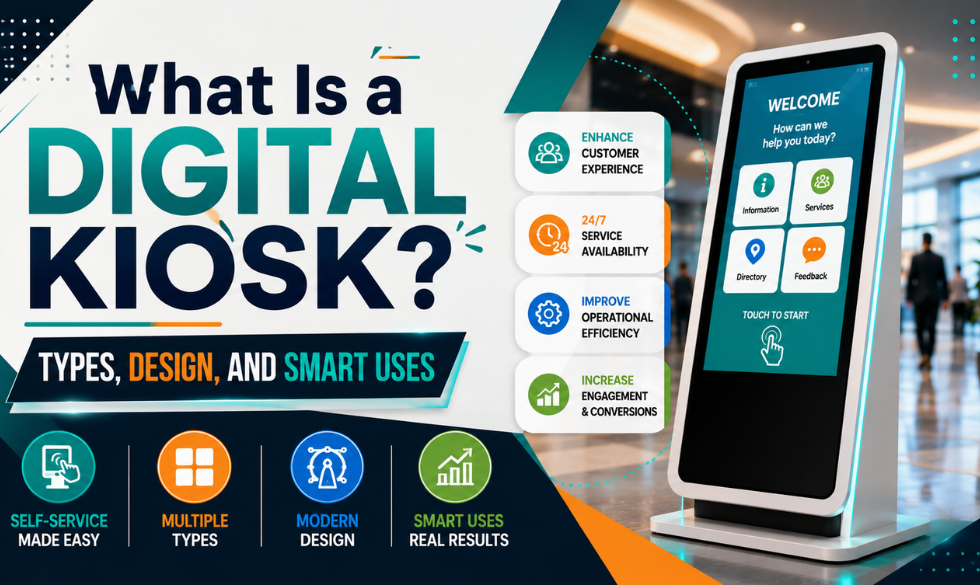
You have used a digital kiosk more often than you realise. The screen where you order a burger without talking to anyone, the machine that prints your movie ticket, the touch display that shows you the way around a mall, the counter where you pay an electricity bill in seconds. All of these are digital kiosks, and they are quietly becoming a normal part of daily life in India.
This guide explains what a digital kiosk is in plain language, where the word comes from, the main types, what good kiosk design looks like, and how businesses across India use them, from food and cafe counters to self-service and payments. By the end you will know exactly how a digital kiosk can work for your business.
What Is a Kiosk?
To define a kiosk simply: a kiosk is a small, standalone booth or station placed in a public space where people can get information, a product or a service. The word originally meant a small open pavilion. Over time it came to mean the little booths you see in markets, malls and streets, and today it most often means a self-service machine with a screen.
So the meaning of kiosk in plain English is a compact, self-contained station that serves people directly, whether that is a newspaper stall, a ticket booth, or a modern touchscreen terminal.
Kiosk full form: is there one?
A common search is the kiosk full form, as if kiosk were an abbreviation. It is not. Kiosk is a complete word, not an acronym, so it has no full form. It comes from the Persian and Turkish word for a garden pavilion or booth, and English adopted it centuries ago. So if you were looking for a full form, the short answer is that there is not one, kiosk is simply a word that means a small booth or self-service station.
What Is a Digital Kiosk?
A digital kiosk is a self-service station built around a screen, usually a touchscreen, that lets people complete a task or get information on their own without staff help. It combines three things: a display, a small computer or media player inside, and software that controls what appears and what the user can do.
The difference from an old-style kiosk is simple. A traditional booth needed a person to run it. A digital kiosk runs itself, can be updated remotely, works around the clock, and can handle everything from browsing a menu to taking a payment. It is the same idea as digital signage, but with interaction added, the user touches the screen and the kiosk responds.

A digital kiosk puts information, ordering and payment directly in the customer's hands
The Digital Kiosk Market in 2026
Self-service has moved from a novelty to an expectation, and the growth shows it, in India and worldwide.
The global market for interactive kiosks is worth around 37.7 billion US dollars in 2026 and keeps climbing. India is one of the fastest movers: its self-service kiosk market is growing at roughly 11 percent a year and is set to nearly double to close to 3 billion US dollars by 2030. Smart-city projects, airport and metro expansion, QSR self-ordering, and UPI-based payments are all pushing kiosk adoption across Indian cities and towns.
Types of Digital Kiosks
Different jobs call for different kiosks. Here are the main types you will see across India, and where each fits best.
Information Kiosk
Shares directions, schedules, directories and general information. The simplest and most common type, used in malls, airports and campuses.
Malls, airports, universities
Self-Service Kiosk
Lets users check in, order, register or apply on their own. Common at airport check-in, hospital registration and QSR counters.
Airports, hospitals, QSRs
Food Kiosk
Self-ordering screens for restaurants, cafes and food courts. Customers browse the menu, customise, and pay, which lifts order value and cuts queues.
QSRs, food courts, cafes
Payment Kiosk
Handles bill payments, recharges and transactions. In India, UPI and QR payments make these fast and popular.
Banks, utilities, parking
Wayfinding Kiosk
Interactive maps that help people navigate large or complex spaces quickly, reducing confusion and staff questions.
Malls, hospitals, campuses
Retail Kiosk
Lets shoppers browse products, check stock and prices, and buy. Modern versions add AI recommendations and virtual try-on.
Stores, malls, trade shows
Food Kiosks and Cafe Kiosks: A Closer Look
Few places show the value of a digital kiosk better than food and beverage. A food kiosk is a self-ordering screen that lets customers browse the menu, customise their order, and pay, all without waiting for a counter to free up. For a busy quick-service restaurant or a cafe, that means shorter queues, fewer order mistakes, and higher average spend, because a screen never forgets to suggest a side or a dessert.
A kiosk cafe setup can be as simple as one self-ordering screen near the entrance or a row of them in a food court. Customers order in their own time and language, the order goes straight to the kitchen, and staff focus on making and serving rather than taking orders. Menus, prices and offers update instantly through the software, so a festive combo or a new item goes live in seconds.
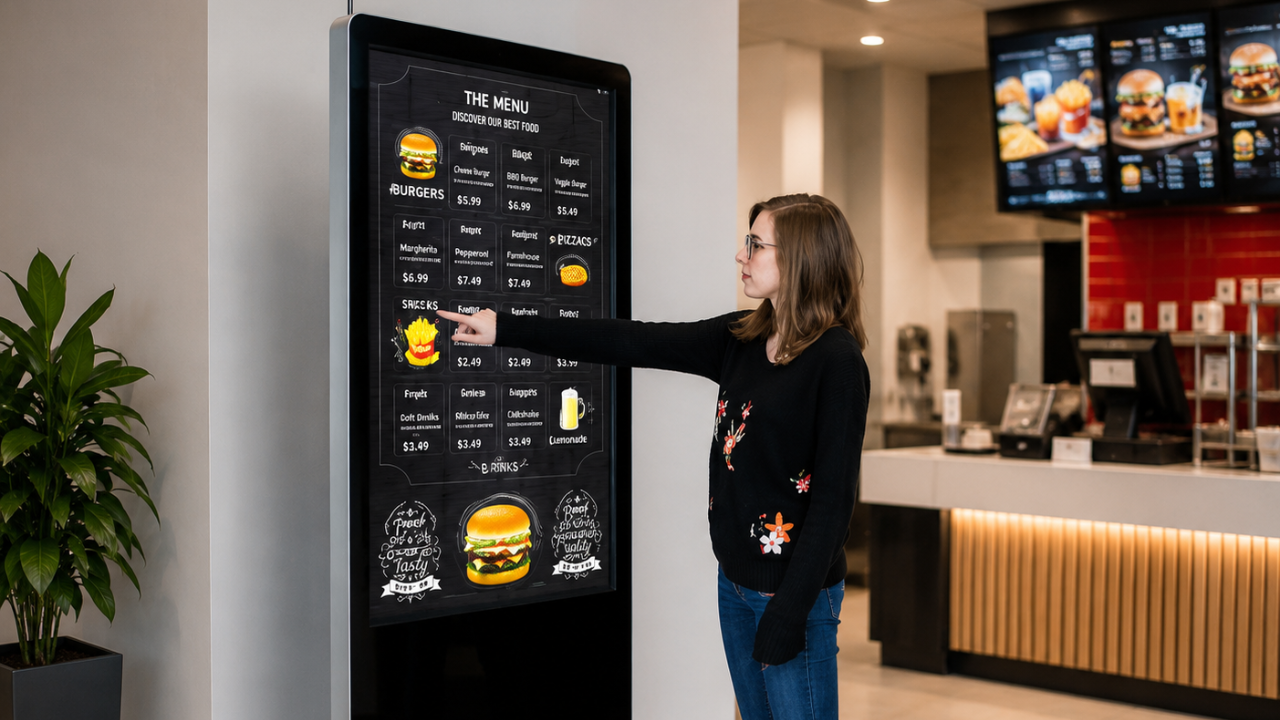
Modern food and cafe kiosks with vibrant menus, overhead signage, and digital ordering screens, displaying fresh pastries and beverages in a compact setup.
What Good Kiosk Design Looks Like
A digital kiosk succeeds or fails on its design. The best kiosk design is not about looking flashy, it is about making the task effortless for a first-time user. Keep these principles in mind.
Simple, guided flow
Lead the user step by step with large buttons, clear labels and few choices per screen. Anyone should finish without instructions.
Readable and accessible
Big text, high contrast, an adjustable or reachable screen height, and multi-language support. In India, offering local languages is a real advantage.
Fast and responsive
Touch should feel instant. Slow screens frustrate users and create queues, defeating the whole purpose of a kiosk.
On-brand and inviting
Colours, logo and imagery should match your brand, with an attract screen that draws people in when the kiosk is idle.
Durable, well-placed hardware
Commercial-grade screens, sturdy enclosures, and placement in high-traffic spots where people naturally pause.
Benefits of a Digital Kiosk
Why are businesses across India investing in kiosks? Because the gains are quick and clear.
| Benefit | What It Means for Your Business |
|---|---|
| Shorter queues | Customers serve themselves, so waiting lines shrink even during rush hours. |
| Higher order value | Smart upsells and clear visuals encourage add-ons, lifting average spend. |
| Lower staff load | Routine tasks are automated, freeing staff for service that needs a human. |
| Fewer errors | Customers confirm their own orders and details, reducing mistakes. |
| 24 x 7 service | Many kiosks run round the clock, serving people outside business hours. |
| Useful data | Kiosks capture what people choose, giving insights to improve your offer. |
Digital Kiosks in India
The kiosk story in India is moving fast. Government Digital India programmes are placing service kiosks across smaller cities, retail chains are rolling out self-service and payment kiosks, and food brands are adding self-ordering screens in outlets and food courts. UPI and QR payments have made transactions instant, and local-language interfaces are opening kiosks to a much wider audience.
For any Indian business, from a single cafe to a national chain, a digital kiosk is now an affordable, practical way to serve more customers with the same team. The key is pairing the right hardware with reliable software that keeps every kiosk online and easy to update.
Power Your Digital Kiosks With Intelisa
A kiosk is only as good as the software behind it. Intelisa's cloud platform runs your touch content, updates it remotely, and keeps every kiosk online and monitored from one dashboard.
- Runs interactive and touch content on any kiosk
- Update menus, prices and content in seconds, everywhere
- Monitor uptime and fix issues without a site visit
- Works offline: kiosks keep running if the internet drops
- Scales from one kiosk to a nationwide fleet
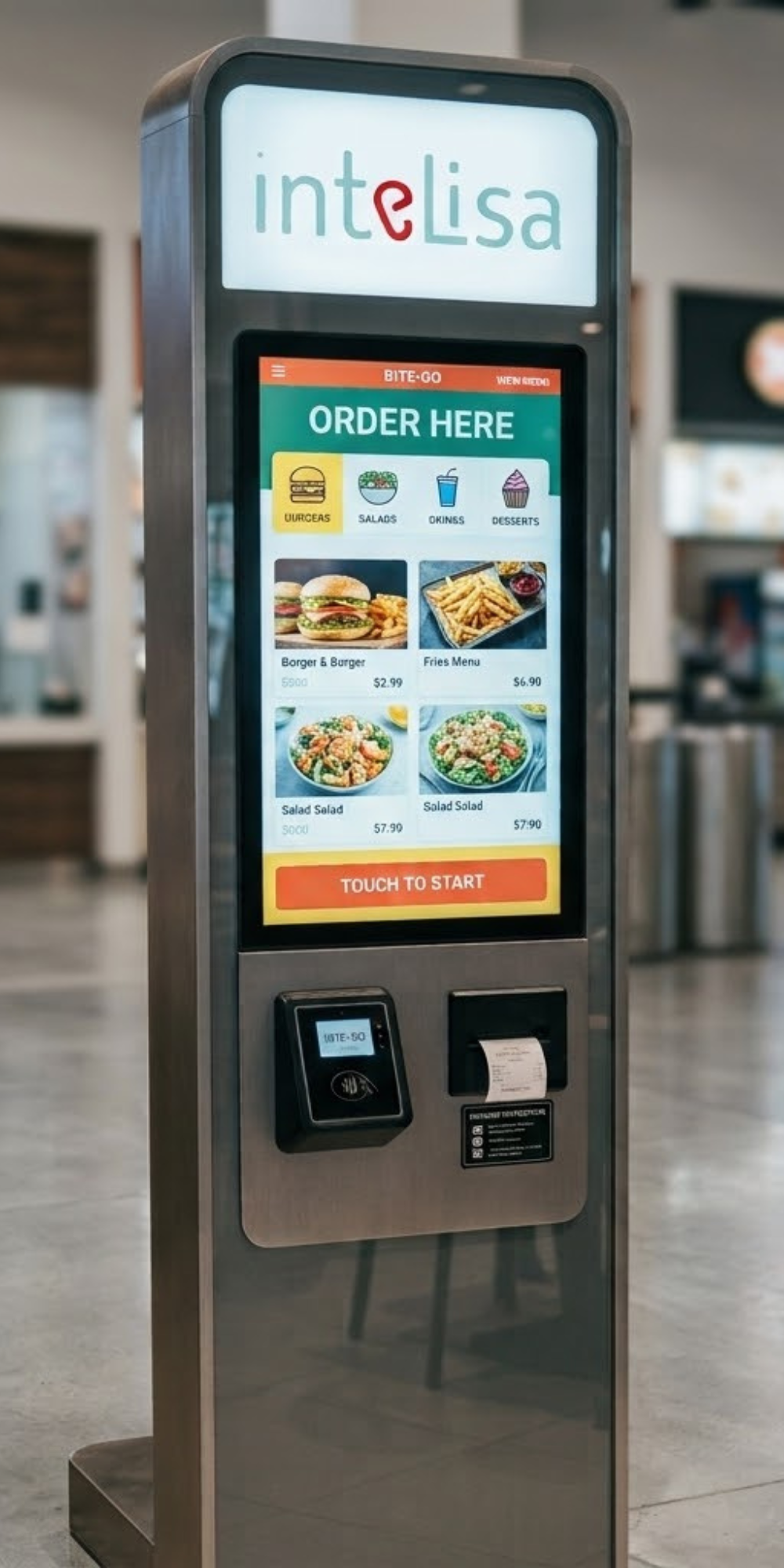
Digital Kiosk vs Traditional Kiosk
The difference becomes clear the moment something needs to change or scale.
| Factor | Traditional Kiosk or Booth | Digital Kiosk |
|---|---|---|
| Needs staff | Yes, someone must run it | No, it is self-service |
| Updating content | Manual, reprint or redo | Instant, remote, from anywhere |
| Working hours | Staffed hours only | 24 x 7 possible |
| Payments | Cash or card at counter | UPI, QR, card, self-service |
| Data and insights | None | Captures usage and choices |
| Scaling to many sites | Slow and manual | One dashboard for all |
Ready to Add a Digital Kiosk to Your Business?
Tell us your use case, from food and cafe ordering to payments, wayfinding and check-in. We will recommend the right kiosk setup and show you how Intelisa runs it all from one dashboard.
Talk to the Intelisa TeamFrequently Asked Questions
What is a digital kiosk?
A digital kiosk is a self-service station built around a touchscreen that lets people complete a task or get information on their own without staff help. It combines a display, a small computer inside, and software that controls the content and what the user can do, from ordering food to making a payment.
What is the meaning of kiosk?
A kiosk is a small, standalone booth or station in a public space where people can get information, a product or a service. In modern use it usually means a self-service machine with a screen, such as a food ordering kiosk, a ticket machine or an information terminal.
What is the full form of kiosk?
Kiosk has no full form because it is not an acronym or abbreviation. It is a complete word that comes from the Persian and Turkish word for a small garden pavilion or booth. So there is no expanded form, kiosk simply means a small booth or self-service station.
What is a food kiosk?
A food kiosk is a self-ordering touchscreen used in restaurants, cafes and food courts. Customers browse the menu, customise their order and pay themselves, which cuts queues, reduces order errors and increases average spend through smart upsells. Menus and prices update instantly through software.
How is a digital kiosk different from a normal kiosk?
A normal kiosk or booth needs a person to run it. A digital kiosk is self-service: it runs on a touchscreen, updates remotely, can work 24 hours a day, accepts digital payments like UPI, and captures useful data. It serves customers on its own while freeing your staff for other work.
What makes a good kiosk design?
Good kiosk design keeps the task effortless: a simple guided flow, large readable text, high contrast, an accessible screen height, local-language support, fast touch response, on-brand visuals, and durable commercial hardware placed in a high-traffic spot.
Are digital kiosks popular in India?
Yes. India's self-service kiosk market is growing at about 11 percent a year and is set to nearly double by 2030. Growth is driven by smart-city projects, airport and metro expansion, QSR self-ordering, UPI and QR payments, and local-language interfaces that make kiosks usable for more people.
What software runs a digital kiosk?
A digital kiosk runs on kiosk or digital signage software that displays interactive content, controls what the user can access, supports remote updates and keeps the kiosk secure. Cloud platforms like Intelisa let you update content and monitor every kiosk from one dashboard.
Conclusion
A digital kiosk turns a simple screen into a self-service assistant that serves customers, cuts queues, and works around the clock. Whether it is a food kiosk in a busy cafe, a payment kiosk at a utility centre, or a wayfinding screen in a mall, the idea is the same: give people a fast, easy way to help themselves. And in India, with UPI, smart cities and local-language support, the opportunity has never been bigger.
What ties every kiosk together is the software running it. With a reliable cloud platform like Intelisa, you can run your touch content, update it instantly across every location, and keep your whole kiosk network online from one dashboard. If you are ready to explore digital kiosks for your business, get in touch with Intelisa.