Categories
Digital Signages

Social Media & Digital Signages

Combining your Social Media Content with On-Ground Digital Signages Make a Great Combination

social media integration

I recently went to my family doctors’ clinic when I was running a slight temperature. Quite ironic, but I was pleasantly surprised during the visit. In its waiting room, the clinic was displaying testimonials from their social media feed. This was a welcome change from the drab static communication that was perpetually pinned up.

Being in the Digital Signage space, I always think of it as a silent victory when I, “as a consumer”, am able to see and benefit from the product. Time and again, I have observed that digital display communication penetrates through to its consumer, like no other.

The effectiveness grows even more exponentially when you tie in social media to it.

Why Display Social Media on Digital Signages?

And what are some powerful ways to build a good campaign?

I attempt to explain:

Break the Dichotomy of Physical and Online World

Owing to separate agencies or teams managing offline and online campaigns/ activations, I have observed that there is often a looming dichotomy between the two spaces, with limited overlap. For example, why can’t a campaign for a kids wear brand that crowdsources pictures online, extend its campaign and display it in their stores, etc. I think the constraint of not having a digital channel at store maybe a reason, which can be overcome by a digital signage medium at the shop floor.

Add 360-Degree Levers for a Campaign

This is an extension of the earlier point. A single campaign should have touchpoints across all channels. For example, a customer visiting a store can engage with a campaign (at the store), and then continue the engagement once back home (through social media). This increases scope for a lasting brand impression and recall.

Reuse Content

Brands churn out quality content for their social media feed almost every other day. Why not reuse it across channels to drive awareness? This not only saves cost, but, I believe, real-time communication across channels is key to breaking communication barriers and silos.

Use the Power of Testimonials, Reviews and Customer Stories

Testimonials, reviews and a good word help like no conventional marketing can, since it is viewed as independent and unbiased. A great feedback, an interesting testimonial can be projected across channels as a shining example of success. One can encourage outstanding service by recognizing employees who bring in such customer delight.

Integrate with Key Processes

Certain key processes greatly help in operations, like queue management in restaurants, with token numbers displayed to inform customers of their orders. One can use digital signages to display these processes and ease operations along with other communication alongside it. A great way to integrate multiple use-cases with a dynamic real-time channel.

Build Engagement

One cannot emphasize enough on building engagement as a tool for brand growth. One of the key pillars to leave behind a lasting brand impression and recall is by engaging with your audience. A two-way conversation is far more impactful given participation from the intended audience.

Try Adding a CTA to Incentivize

Incentives to trigger action are also a great way to enable a two-way conversation as mentioned earlier. For example, a small prize or some recognition, can go a long way to trigger participation.

Bridging the Online and Offline Worlds

There are many such useful methods to integrate the online with the offline.

Intelisa helps you with all the features that are required to enable a 360-degree campaign.

We will be happy to assist you with ideas based on the space and sector you operate in. Give us a ring, drop us a line, we are always happy to connect and brainstorm!

Categories
Digital Signages

2021 Digital Signage Display Report

A glance at the latest features in digital displays and the technology that’s behind it

by Alok Dukle

digital signage displays

Digital Signage displays have come a long way. The good old cathode ray tube (CRT) technology for televisions, that was housed in a big box, was revolutionary at its introduction, but now practically extinct.

Over the years, of course, new digital display technologies significantly outshone it in features and cost effectiveness.

advanced display innovations

5 Key Trends in Digital Display Innovations

So before we venture into display technology, let’s go through some features in digital displays that I came across in exhibitions, research papers and articles. These are 5 trends I saw that I particularly found interesting:

1. a. Rollable TV’s

One of the hottest innovations in televisions was showcased at CES recently – LG’s incredible rollable TV, a 65-inch OLED television that’s ‘foldable’ – it actually rolls up out of a horizontal cabinet base. When stacked in front of your bed, it is perfect to unveil and watch television, and other times can be used as a seat and music player. All in all, quite unreal – check it out below:

b. Rollable & foldable phones:

Rollable & foldable phones are pretty mind-blowing as well since, in a sense, they can potentially convert a phone into a tablet! Check out this video to understand this:

2. Haptics

Another interesting upcoming feature in display is called ‘haptics’. With haptics, one can ‘feel’ the screen which creates sensations when touched. Imagine buying a top/ shirt on Amazon: With this great feature, you could actually feel the cloth before buying it. A very interesting technology which allows the sense of ‘touch’ to be enabled on displays, in addition to visual (screen) and audio (speakers).

3. Bendy-Flexi-See-through OLED’s

LG Displays showcased a whole host of features pumped into their OLED this year – from see-through displays to bendable ones. Watch this stunning video.

The applications of see-through displays are no-doubt interesting. Almost 60% of the screen surface is see-through, so displays can effectively be used in fast food restaurant counters – wherein one can view the display as well as the person on the counter behind it. Particularly useful in the Covid-19 pandemic as well- to create a shield between customer and store personnel.

The bendable displays have an interesting application in gaming too – they create an immersive experience for games, given that the screens are bent and aligned to the way we actually see. Check out the video to understand this!

4. Augmented Reality (AR) / Virtual Reality (VR)

Augmented Reality (AR) / Virtual Reality (VR)

This interactive virtual concierge robot is an example of AR at work, and was showcased in a recent symposium for Digital Displays. The concierge was charming, almost human-like, and interacted with customers socially about products. For example, she waved her hand to attract the attention of potential customers. She then had a social conversation and conveyed salient points about products, and answered questions along the way – just as a store personnel would do!

The assistant was actually projected on glass that can serve as a transparent glass ordinarily, and then as a projection screen for augmented reality, when required.

Given an advanced ability to interact, one can imagine the possibilities this opens up – contactless shopping, personnel-less stores, to name a few.

Many such applications around AR and VR are slowly unfolding.

5. Coloured e-ink and more

This is a display system I am particularly quite interested in – of course, best known from the Kindle displays.

They are drastically different from regular displays, and bring forth their own set of advantages. The people at E-ink rightly point out, that the technology is not meant to be a replacement for digital displays, but for paper!

Its advantages like extremely long battery life, very low power requirement, no eye strain and artistic appearance, completely disrupt the space. However, limitations like able to only display images (not videos), very low refresh rate, and so on, make it placed in a completely different segment from digital displays.

In its independent space, e-ink technology is now releasing features of enabling colour, currently at 4096 shades of colours and around 16 levels of grayscale. Great space to keep a tab on!

Coloured e-ink and more

Now, most of the above advanced features are still not out in the mass market, since they aren’t cost-effective as yet for being adopted. However, thanks to the speed of R&D we will get there soon!

The features, of course, are only possible thanks to advanced display technologies.

In this next section, let’s take a look at how display technologies have evolved over time, and made the features we saw earlier possible. Here’s the evolution of display technologies:

The well-known Liquid Crystal Display (LCD)

In the year 2007, the image quality of LCD displays surpassed that of the traditional CRT TV’s. And almost immediately towards the end of the year, there was a formidable shift in the space – more LCD’s were shipped as compared to CRT’s. And over time, of course, CRT’s were rendered extinct!

Liquid Crystal Display (LCD)

Evolution Pattern: CRT → LCD → LED → OLED → QLED → Micro LED

LCD Screens and their evolutions

LCD’s, in order to make images visible, need a backlight. Earlier this light was in the form of CCFL’s (cold cathode fluorescent lamps) which were placed on the opposite edges of the display. This was the key technology used for many years.

However, with time, CCFL’s began getting replaced by LED’s (Light Emitting Diodes) which were more efficient than CCFL’s.

Did you know that the LED televisions we see today are basically LED backlit LCD displays? Unlike what people presume, they aren’t ‘LED televisions’ in themselves. Pure LED’s still command a premium price, but are slowly making their in-roads to the mass market.

The New Age LED’s: The era of LED, OLED, QLED and AMOLED

Outdoor displays use the pure form of LED’s, since they are generally seen from a distance and need to be bright, given the daylight. They are useful for outdoor billboards, but generally not used indoors.

OLED which stands for Organic Light emitting diode, is actually a pure LED technology for indoor displays.

Followed by QLED & AMOLED, and others, which for understanding sake, are essentially variations of the OLED.

The advantages are that they produce a much higher quality output versus previous technologies, they are brighter, require no backlighting and also produce ‘true blacks’.

The current LED’s, due to backlight, are not capable of producing deep blacks. Whereas, since OLED’s are lighted up by individual pixels, they do not produce light when off and remain totally black.

LED’s

Traditional LED’s (LED backlit LCD’s) versus OLED’s

These new-age LED’s are now being adopted, and LCD is on the decline, similar to how, in fact, LCD’s had overtaken CRT’s way back in 2007.

Samsung and LG, recently, both halted their domestic production of their traditional LCD’s to focus more on these newer LED technologies.

display technology evolution

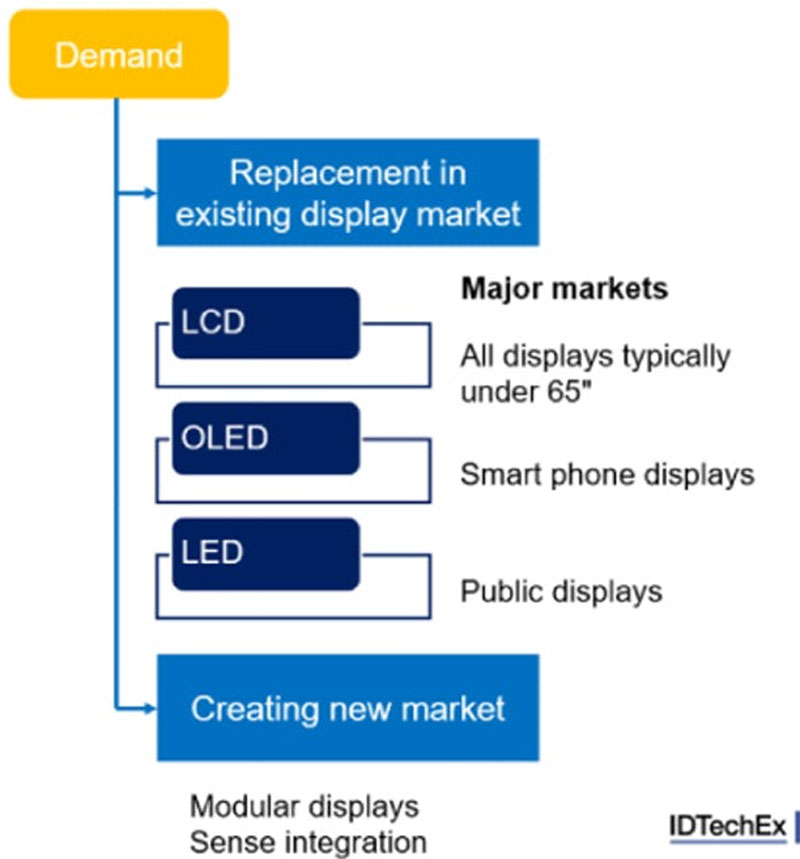
Demand and supply of Micro LED displays. Source: IDTechEX

The Future LED’s: Micro LED’s

Micro LED’s are what many believe to be the next generation of display technology. MicroLED displays offer a wide range of additional features such as wide colour gamut, high luminance and contrast, wide view angle, transparency, seamless connection, and sensor integration capability, among others.

Most of the advanced features which are releasing now like bendable, foldable and see through displays, like we saw earlier, are thanks to this technology.

Given the possibility of sensor integration, it can also engage with audiences.

Advanced technologies like cloud, ML & AI integrated with the displays are able to create the virtual concierge that we saw earlier.

Here is a handy graph that summarizes these display technologies.

The Future of LED’s

Value propositions of various display technologies. Source: IDTechEx

E-paper, of course, being in a separate segment, and as explained earlier is not included in the comparison, but is an interesting technology in itself.

So that sums up an overview of the latest trends that we see in display signages and the host of features and possibilities that it opens up.

As a result of this, I see many interesting applications of digital signages and digital displays, that will make their way through and affect industries like consumer, retail, advertising, hospitality, and more.

After all, looking fundamentally, effective communication and engagement with customers across industries will lead to a higher output.

It’s an exciting road ahead in the digital signage and digital display space and I, for one, can’t wait to experiment on prototypes and build product

Categories
Digital Signages

7 reasons why Digital Signages make an impact on business

What is Digital Signage?

Digital Signage technology is a fast growing tech-space that drives communication to audiences physically through digital screens.

How Digital Signage is Used Across Sectors

Digital signages can be used across sectors: Think of digital screens in a retail store, that communicate offerings to customers from the central marketing team at real-time.
Or in a corporate that integrates employee engagement related campaigns and drive best practice sharing across the organization.
You can read more on its applications across sectors on our website, especially across Retail, Restaurants, Corporates  and Manufacturing.

How Digital Signage is Becoming More Intelligent

Off late, and thanks to advancements in underlying technologies, communication through digital signages has become more intelligent. Here are some interesting features that make for compelling reasons to think of how a Digital Signage maybe applicable to your business.

Key Benefits of Using Digital Signage for Your Business

Reason #1: Show products and offerings at real-time and amplify sales

Did you know that a product that is well-highlighted in a store, sells upto 2X-3X times a product that is not highlighted.
When a customer is at the point of sale, the most valuable asset is your time with him or her, which can be used to communicate more effectively.
By showing product communication and updates at real-time, your communication efficiency to customers is greatly enhanced.

Reason #2: Show more products by new communication every few seconds

With digital screens, you are no longer constrained by the number of creatives you can show.
A number of messages, products and offerings can therefore be conveyed to customers, through the same medium.
This directly implies a better use of real-estate.

Reason #3: Reduce the lag between what you want to show and what is shown

At times, strategic communication at retail outlets needs to be planned well in advance, so as to communicate it at the point of sale correctly.
Often this results in communication of offerings which are irrelevant, or simply not in the store (due to being stock-out, etc).
With digital signages, however, communication becomes more instantaneous and dynamic, and there is no lag between what you want to communicate and what you actually do.

Reason #4: Make your signage network intelligent

With the advent of advanced underlying technologies, signage networks are far more intelligent than they were.
Think of each digital signage display as an intelligent unit, which can schedule communication based on the time of day, local sales patterns, live in-store demographics and more.
Personalization of communication can be achieved at different levels.
This results directly in sales amplification.

Reason #5: Compelling dynamic creatives

One of key reasons why digital signages garner upto 2X attention versus static communication, is simply because they are brighter (due to it being an LED display) and the creatives can be dynamic (moving).
Small movements in creatives substantially increase viewership levels.

Reason #6: Measure precise ROI

It is always important to measure and get a bang for the buck.
Marketing spends can be better optimized by measuring ROI of channels.
Digital signages help us estimate ROI by various parameters: like measuring viewership or impressions i.e. number of customers who saw the creatives, their demographics, attention span to the creatives, and many more.

Reason #7: Add engagement to your customer interactions

Digital signages, once installed, can be augmented with sensors, through which the same display can be used with a layer of added engagement.
Be it use cases like virtual trial rooms, or a social media engagement campaign, a number of such ideas can be added on top of the digital signage foundation.
Our earlier article on “5 coolest digital signages from across the world”, gives a few exciting applications of the technology.

To conclude, digital signage technology is a nascent but growing technology which helps catapult efficient stakeholder communication.

It has applications across sectors, and in case some of the reasons above echo with your business need, do try out our free trial to pilot the features for growing your business.

Categories
Digital Signages

Case Study: Smart Notice boards

by Anvesh Mantena

Anvesh Mantena is Co-Founder & COO of Intelisa with over a decades experience as a digital technology consultant across global markets like US, Japan, Germany & India.

Executive Summary:

The trend for integrated townships with private living, high security, and advanced amenities has been on a steep rise over the last couple of decades. It perfectly combines privacy of space with a taste of community and built-in amenities, and has created a one-stop destination to family living.

Privacy is an integral part of a township. The residents do not want to be disturbed by salesman at their doors, or pesky marketing material that filter through barriers. However, from the viewpoint of brands, these customers need to be reached in order to communicate offerings.

This is evident from the fact that these Housing societies receive an average of 20 requests every day for access!

Intelisa, the next-gen digital signage solution, in partnership with a prominent media agency created an innovative WIN-WIN solution for such housing societies as well as marketers by deploying large LED TV’s at strategic locations across societies. These screens were divided into two parts, with one part controlled by the media agency to run advertisements and marketing material (ads), while the other part managed by the township as a smart notice board for internal communication.

benefits of digital notice boards in apartments

This greatly reduced the operational effort required by society for internal Communication by 80%. The communication on screens has 85% higher engagement and retention compared to posters on notice boards. This automatically brought high viewership for ads that were running in parallel.

Business Scenario and Challenges:

Let us take one housing society in which we deployed our solution – With 14 blocks and 2000 family residents, there is evidently a continuous stream of communication and the management of the same. It is a mini-city in itself with a lot of planning, be it for maintenance, day-to-day essentials, events, celebration, etc. A management team is generally constituted who is responsible for making the choices on a lot of these daily activities and these have to be communicated effectively to all the residents. Here were the challenges the management team used to face:

  • Everyday, on an average, there is at least 1 notice that needs to be communicated to all residents.  The old method of having a person reach every house to communicate the message is unviable with 2000 units.
  • With the plethora of email that people receive on a daily basis, these society emails are lost in the clamour.
  • Social messaging chats like WhatsApp can only accommodate 256 people so having multiple different WhatsApp groups makes it difficult to manage.
  • Physical Notice board at lift lobbies were an option. However, this involved operational challenges of physically putting up the notices and monitoring them, as well as a lot of printing involved.

While all this was internal communication, there were external factors as well. On an average, the society received at least 20 requests from various prominent brands for distributing product promotions, for door-to-door marketing access, for placing posters on notice boards, and so on.  The advent of COVID-19 has forced societies to follow a strict check on people entering and leaving society.

How Intelisa Helped:

Intelisa in partnership with a popular media house in Hyderabad developed a unique offering to address multiple challenges of the township.  Large 55 inch UHD digital screens were placed strategically across key places throughout the township. Intelisa’ s technology split these screens in a 60-40 ratio, where 60% was offered to partner media agency to run external ads/promotions while 40% was offered to the Society management to run Internal communication messages.

benefits of digital notice boards in apartments

Each party had a unique login without any interference with each other All the advertisement request were now routed to the media house there by reducing the burden on the society, Intelisa’s capability allowed the Media agency to:

  • Run hyperlocal advertisement all from their office in regular time slots
  • Update ads with a click of a few buttons in real-time
  • Preview the content playing on each of the screens in real-time
  • Screen status reporting (ON/OFF) as well as quickly troubleshoot in case of issues.
  • Directly email customers with details on their ads total screen time and its repetition frequency.

Similarly, the society passed a resolution to keep all internal communication on these new digital notice boards, thereby reducing the operational challenges of having to print notices or having to send door to door messages. Intelisa’s capability allowed society to:

  • Schedule notices in the form of PDF files
  • Live preview the content playing on the screen, add/modify/delete notices with a click of a few buttons.
  • Run engaging content like event photos, competitions, video messages, etc.
  • Earn additional revenue for all the advertisements that are routed through the media agency by society.

Results, Return on Investment and Future Plans:

Intelisa’s Digital signage solution offering has built an opportunity for marketers to reach out to the customer closer to their homes, in a non-pervasive way and in the process also has enabled housing society to adopt the digital platform for internal communication and reduce operations overhead creating a WIN-WIN situation for all the stakeholders.
The following are the key benefits for each of the stakeholders:

Housing Society

  • Increase in revenue from advertising income for the society.
  • Increased awareness of maintenance updates and participation in community events. As per the society, participation in events has increased by at least 50% percent, after the introduction of digital notice boards.
  • Printing for notices completely eliminated (>95%), which is one step closer to making the society eco-friendly and resulting in a cost-saving of at least 10% on monthly stationary expenses.
  • Avoid access to external people moving inside the society for marketing purposes, thereby ensuring higher security compliance which includes Covid safety protocols.
  • Increase access to bulk marketing deals offered exclusively for the society from hyperlocal brands.

Marketing Agency

  • Access to a targeted set of audience, as close to the home as possible.
  • 70-90% ad slot utilization, on any day with a lot of request from SME and hyperlocal companies.
  • Ability to add/delete/modify marketing content from their office in real time without any other operational overhead.
  • Very high viewership estimated to be at least 40% of the residents on a daily basis. Given that these notice board were the key means for internal communication, almost every resident would pause to take note of the screen communication.
  • Real-time reports to track and monitor campaigns on various different screens.
  • Run all kinds of media be it video, images, document, or directly stream from the Internet.
  • Transparent reporting on total screen time as well as advertisement  repetition frequency across all the screens

COVID-19 has only accelerated the Returns for the marketing agencies with more and more brands trying to look for media as close to the consumer’s home as possible. With the success of this model, the agency is already in talks with more societies to replicate and expand.

Categories
Digital Signages Everything IoT

IoT based Digital Signages will gain significance during COVID-19

by Mr. Anvesh Mantena

Note: The author of this article has over a decades experience as a digital technology consultant across global markets like US, Japan, Germany & India.

With the world heading towards a new normal, next generation IoT based digital signages are set to play a significant role to not just help business navigate the current operational challenges, but increase their preparedness to mitigate the impact of such challenges in the future. 

The words corona, social distancing and lockdown were virtually unheard of, a few months ago. The COVID-19 pandemic has affected millions of people and disrupted thousands of business worldwide. The reality of the outbreak is starting to settle in and business leaders are strategising to navigate a broad range of interrelated issues. One of the key business challenge that is industry agnostic, is ensuring health and safety of employee and customers. 

The fact that a vaccine is still months away, amplifies the relevance of digital signage which has taken up the role of providing the most important commodity of all: information. If the importance of digital signages was ever a question before Covid-19, there is no doubt of its value now.

Although it seems obvious, the need of the hour is to continuously remind your customers & employees about importance and safety related information to further drive the point. The cloud based solutions give complete control to the head office to drive emergency communication in real time to multiple or a specific remote location. Digital signages are all set to play a prominent role to keep people informed and fight against their fears at places where it matters the most.

While enabling communication remains to be the key, the next generation digital signage solution which are IoT based and are driven by AI, will works as a platform to build industry specific application that would not just help businesses navigate through the current pandemic but will increase their preparedness to mitigate the impact for the next one if any.

The below are a few use cases which we would see gaining traction

  • Remote training: While training is a key for businesses to grow the current pandemic has been driving a wide range of reskilling initiative by organizations, virtual meeting tool like Zoom are helping white collar employees, the same can’t be said with blue collar employee. This is where digital signage are set to play a significant role. The real-time capabilities of the modern signage solution will help business reuse the screens placed at strategic point across factory floor to train workers.
  • Queue Management: Queues for entry into retail stores, is quite common these days. This will further formalise into appointment based shopping. IoT based digital screens installed at entrances of stores apart from its basic functionality to act as a medium of communication will also provide queue management services to regulate the inflow of customers thereby avoiding the pile-up of people in endless lines and increase the confidence of the customer to come and shop with them.  
  • Remote monitoring: With high levels of compliance standards being set by governments, organisations will need tools to monitor their implementation at manufacturing plants or retail stores. The next generation digital signages based on IoT platforms, integrated with sensor technology will eliminate blind spots, giving management a holistic view of operations that can be monitored remotely. In-built algorithms will automatically alert staff by bringing up relevant messages on screens at times when standards are not being met by employees. 
  • Local Community marketing: ‘When customer don’t come to you, you go to your customers’, is the mantra that businesses will follow. The advertisement spent for organisations will be very limited and targeted with companies being very particular on where every rupee is spent. Marketing in public places through OOH might lose its sheen with more marketers looking to reach the customer as-close-to-home. This will open up avenues for marketing agencies to invest in digital screen controlled by an efficient cloud solution in various large housing societies, which will take brands closer to the customers. Digtial signage solution will provide real time analytics on the advertisements making the business investments measureable. 
  •  Contactless attendance & screening: Finger print recognition has been a standard over the last decade for daily attendance registration at various offices/plants across the world. This pandemic has brought about an urgent need for a contactless technology.  Face recognition which is already making its presence in the mobile world will be the new normal. The camera scan along with a few thermal scanning sensors will see integration with IoT based digital signages for automatic attendance capture and screening at entrances with capabilities to automatically trigger warning messages.
  • Store Information & availability display:  In the short term, window shopping at malls will reduce due to the fear of infection, and customers will shop for a particular pre-decided product. The time they want to spend in stores will be minimal. In these scenarios, real time information on the availability of product and their exact location will be of great help for people to directly walk to the product pick it up and check out. Digtial signage’s will play a significant role by integrating the store inventory & layout diplaying real time product information and their availability. 

With the changing global context, Digital Signages are maturing from just being a marketing tool to an IoT based enabler by integrating real time applications, resulting in being an efficient and effective communication of the one of the most important asset – information!