Categories
Digital Signages

2021 Digital Signage Display Report

A glance at the latest features in digital displays and the technology that’s behind it

by Alok Dukle

digital signage displays

Digital Signage displays have come a long way. The good old cathode ray tube (CRT) technology for televisions, that was housed in a big box, was revolutionary at its introduction, but now practically extinct.

Over the years, of course, new digital display technologies significantly outshone it in features and cost effectiveness.

advanced display innovations

5 Key Trends in Digital Display Innovations

So before we venture into display technology, let’s go through some features in digital displays that I came across in exhibitions, research papers and articles. These are 5 trends I saw that I particularly found interesting:

1. a. Rollable TV’s

One of the hottest innovations in televisions was showcased at CES recently – LG’s incredible rollable TV, a 65-inch OLED television that’s ‘foldable’ – it actually rolls up out of a horizontal cabinet base. When stacked in front of your bed, it is perfect to unveil and watch television, and other times can be used as a seat and music player. All in all, quite unreal – check it out below:

b. Rollable & foldable phones:

Rollable & foldable phones are pretty mind-blowing as well since, in a sense, they can potentially convert a phone into a tablet! Check out this video to understand this:

2. Haptics

Another interesting upcoming feature in display is called ‘haptics’. With haptics, one can ‘feel’ the screen which creates sensations when touched. Imagine buying a top/ shirt on Amazon: With this great feature, you could actually feel the cloth before buying it. A very interesting technology which allows the sense of ‘touch’ to be enabled on displays, in addition to visual (screen) and audio (speakers).

3. Bendy-Flexi-See-through OLED’s

LG Displays showcased a whole host of features pumped into their OLED this year – from see-through displays to bendable ones. Watch this stunning video.

The applications of see-through displays are no-doubt interesting. Almost 60% of the screen surface is see-through, so displays can effectively be used in fast food restaurant counters – wherein one can view the display as well as the person on the counter behind it. Particularly useful in the Covid-19 pandemic as well- to create a shield between customer and store personnel.

The bendable displays have an interesting application in gaming too – they create an immersive experience for games, given that the screens are bent and aligned to the way we actually see. Check out the video to understand this!

4. Augmented Reality (AR) / Virtual Reality (VR)

Augmented Reality (AR) / Virtual Reality (VR)

This interactive virtual concierge robot is an example of AR at work, and was showcased in a recent symposium for Digital Displays. The concierge was charming, almost human-like, and interacted with customers socially about products. For example, she waved her hand to attract the attention of potential customers. She then had a social conversation and conveyed salient points about products, and answered questions along the way – just as a store personnel would do!

The assistant was actually projected on glass that can serve as a transparent glass ordinarily, and then as a projection screen for augmented reality, when required.

Given an advanced ability to interact, one can imagine the possibilities this opens up – contactless shopping, personnel-less stores, to name a few.

Many such applications around AR and VR are slowly unfolding.

5. Coloured e-ink and more

This is a display system I am particularly quite interested in – of course, best known from the Kindle displays.

They are drastically different from regular displays, and bring forth their own set of advantages. The people at E-ink rightly point out, that the technology is not meant to be a replacement for digital displays, but for paper!

Its advantages like extremely long battery life, very low power requirement, no eye strain and artistic appearance, completely disrupt the space. However, limitations like able to only display images (not videos), very low refresh rate, and so on, make it placed in a completely different segment from digital displays.

In its independent space, e-ink technology is now releasing features of enabling colour, currently at 4096 shades of colours and around 16 levels of grayscale. Great space to keep a tab on!

Coloured e-ink and more

Now, most of the above advanced features are still not out in the mass market, since they aren’t cost-effective as yet for being adopted. However, thanks to the speed of R&D we will get there soon!

The features, of course, are only possible thanks to advanced display technologies.

In this next section, let’s take a look at how display technologies have evolved over time, and made the features we saw earlier possible. Here’s the evolution of display technologies:

The well-known Liquid Crystal Display (LCD)

In the year 2007, the image quality of LCD displays surpassed that of the traditional CRT TV’s. And almost immediately towards the end of the year, there was a formidable shift in the space – more LCD’s were shipped as compared to CRT’s. And over time, of course, CRT’s were rendered extinct!

Liquid Crystal Display (LCD)

Evolution Pattern: CRT → LCD → LED → OLED → QLED → Micro LED

LCD Screens and their evolutions

LCD’s, in order to make images visible, need a backlight. Earlier this light was in the form of CCFL’s (cold cathode fluorescent lamps) which were placed on the opposite edges of the display. This was the key technology used for many years.

However, with time, CCFL’s began getting replaced by LED’s (Light Emitting Diodes) which were more efficient than CCFL’s.

Did you know that the LED televisions we see today are basically LED backlit LCD displays? Unlike what people presume, they aren’t ‘LED televisions’ in themselves. Pure LED’s still command a premium price, but are slowly making their in-roads to the mass market.

The New Age LED’s: The era of LED, OLED, QLED and AMOLED

Outdoor displays use the pure form of LED’s, since they are generally seen from a distance and need to be bright, given the daylight. They are useful for outdoor billboards, but generally not used indoors.

OLED which stands for Organic Light emitting diode, is actually a pure LED technology for indoor displays.

Followed by QLED & AMOLED, and others, which for understanding sake, are essentially variations of the OLED.

The advantages are that they produce a much higher quality output versus previous technologies, they are brighter, require no backlighting and also produce ‘true blacks’.

The current LED’s, due to backlight, are not capable of producing deep blacks. Whereas, since OLED’s are lighted up by individual pixels, they do not produce light when off and remain totally black.

LED’s

Traditional LED’s (LED backlit LCD’s) versus OLED’s

These new-age LED’s are now being adopted, and LCD is on the decline, similar to how, in fact, LCD’s had overtaken CRT’s way back in 2007.

Samsung and LG, recently, both halted their domestic production of their traditional LCD’s to focus more on these newer LED technologies.
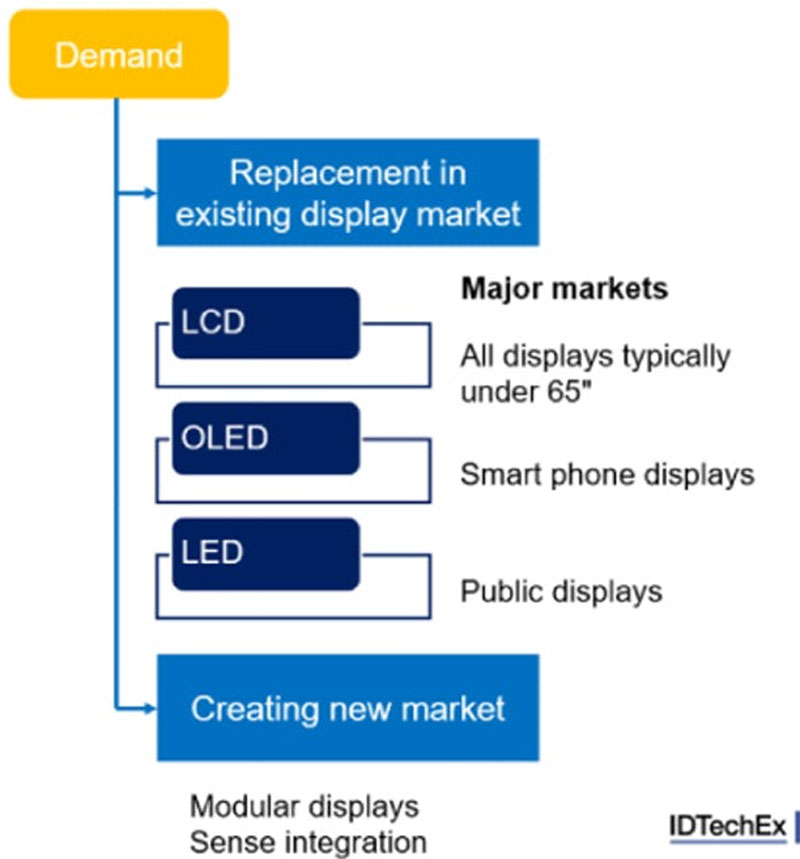
display technology evolution

Demand and supply of Micro LED displays. Source: IDTechEX

The Future LED’s: Micro LED’s

Micro LED’s are what many believe to be the next generation of display technology. MicroLED displays offer a wide range of additional features such as wide colour gamut, high luminance and contrast, wide view angle, transparency, seamless connection, and sensor integration capability, among others.

Most of the advanced features which are releasing now like bendable, foldable and see through displays, like we saw earlier, are thanks to this technology.

Given the possibility of sensor integration, it can also engage with audiences.

Advanced technologies like cloud, ML & AI integrated with the displays are able to create the virtual concierge that we saw earlier.

Here is a handy graph that summarizes these display technologies.

The Future of LED’s

Value propositions of various display technologies. Source: IDTechEx

E-paper, of course, being in a separate segment, and as explained earlier is not included in the comparison, but is an interesting technology in itself.

So that sums up an overview of the latest trends that we see in display signages and the host of features and possibilities that it opens up.

As a result of this, I see many interesting applications of digital signages and digital displays, that will make their way through and affect industries like consumer, retail, advertising, hospitality, and more.

After all, looking fundamentally, effective communication and engagement with customers across industries will lead to a higher output.

It’s an exciting road ahead in the digital signage and digital display space and I, for one, can’t wait to experiment on prototypes and build product

Categories
Everything IoT

IoT Trends in 2021: Is IoT worth the buzz?

by Alok.

Internet of Things (IoT) is a term that has been turning heads since the last few years. But one needs to tread cautiously with fancy terms. Time and again, we have witnessed that they may not, unfortunately, be worth the noise and attention they get.

In this article, we take a hard look at relevant data to decide if it is worth the buzz…..

Global Trend of Connected Devices

Where better to begin than with the global trend of number of connected devices, which gives a clear picture of IoT deployments globally. In fact, without looking at applications, one can just observe the chart (given below) with its year-on-year numbers, and they tell you a story.

To summarize: 21.7 billion device connections have been deployed cumulatively as in 2020. To put it in context that’s 2.9 connected devices per person globally! (basis the latest census that estimates a ~7.5 billion world population)

connected IoT devices

One thing to note though: Every connected device is not an IoT device as per our IoT definition, which results in an important and fundamental question:

What makes an IoT device?

‘IoT Analytics’ defines the Internet of Things as a network of internet-enabled physical objects.

What basically this means is that IoT devices contain independent intelligence. The physical device is connected to a cloud and operates ‘independently’. Smartphones, tablets, laptops, are NOT IoT devices by this definition.

With 11.7 bn pure IoT devices as in 2020, the other key point that we absorb from this chart is the fact that 2020, in fact, has been a milestone year for IoT. This is because for the first time, the number of IoT devices crossed the number of non-IoT connected devices globally.

The acceleration in growth rate (from 10% between 2010 to 2020, to 13%, 2020 onwards) demonstrates the growing spurt in the sector.

Is the Growth Backed by Revenue?

So the ‘number of devices’ statistic look encouraging, but is it backed by real revenues and money invested?

For a long time, a consistent criticism to IoT has been its low maturity resulting in low or no monetization. Which means even if devices were being pumped into the ecosystem, the revenue and investments made for them was not substantial.

This seems to have taken a turn lately, which signifies maturity in certain segments:

Statista boasts that the global IoT market grew from $100bn in 2017 to $212 billion in 2019, and suggests it would reach $1.6 trillion by 2025 worldwide. Even after rounding down the figures, that’s an estimated growth of approximately 7X in 7 years.

Business Insider is even more bullish, saying the IoT global market will grow to over $3 trillion by 2026!

With number of connected devices and revenues presented, here are the sectors that are the growth drivers.

IoT device management

Key Sectors Driving Growth

A BCG research report points out that ‘Discrete manufacturing’, ‘Logistics’ and ‘Transportation’ are key sectors for whom ‘the time has come’ with respect to IoT. In fact, 50% of the current overall spending in IoT is from these sectors.

What’s more interesting, is that with time, IoT applications will mature in other sectors like utilities, healthcare, automotive and retail. And hence the sustained year-on-year growth that we saw in the earlier charts.

Key Benefits of IoT Applications

But what are the end-user applications that are sustaining this growth? And what benefits are users deriving from IoT use-cases?

Based on multiple surveys and research reports,  these are the collated key benefits that we distilled out:

Transparency and Easier monitoring:

We can optimize any variable only after we can measure it by some means. One key driver that has boosted applications around IoT is its ability to give visibility to measurement. Be it temperature sensors for boilers, physical location for trucks, vital checks for patients, and more, visibility gives rise to transparency. By the virtue of ‘knowing’ the location of physical assets, organizations can create dashboards which are very handy for monitoring.

Better decisions

The next step after monitoring is to enable better decision making. From new sets of data, one can take more informed decisions. Output can be then benchmarked against desired outcomes, be it saving costs, increasing efficiency, and so on.

Automating tasks

One can also automate tasks by rule-based algorithms, as a result of the increased visibility. This is, of course, and extension to better decision making. Only that in this case it is automated rather than manual.

Cut energy cost

This is a specific outcome increasingly being drawn as a result of IoT implementation, and hence has merit to give a special mention. Through sensors and automated building/ factory management, one can optimize energy costs expended by various activities on real-time data. This optimizes and hence cuts energy costs tremendously.

Predictive maintenance

This is another area which deserves a special mention. Through sensors, one can increasingly monitor and predict when certain parts of large and complex machinery and infrastructure can fail. Doing this proactively, has found to save a tremendous amount of money and effort.

Increasing engagement

Finally, with increasingly dynamic output, IoT devices have the ability to engage audiences with intelligent communication. This is, of course, an area we are particularly deep in, and Digital Signage Technology is a space that we see has great potential to build engagement at the point of sale.

Lest we forget, one cannot evaluate an industry in present times, without looking at the implications that the Covid pandemic would have on it.

Overall, we have seen an increase in technology adoption as a result of the pandemic since it helps remote communication and reduces physical contact/ intervention.

The IoT industry too, in the long run, is likely to be enabled as a result of the pandemic. Customers would demand remote deployments and monitoring, which means more devices deployed. However, in the short run, with certain industries largely affected, investments in new technologies may get postponed to a better day. Hence, strained in the short run but favourable in the long term, can be concluded as an outcome of the pandemic.

Finally, we check for ‘side-effects’. IoT at its core may be a boon, but the threats should not outweigh its value. The key area that needs mention here is ‘security’. Data & IT security becomes increasingly important with the many endpoints connected as part of the IT ecosystem, as they can be vulnerable to being exploited.

A Gartner report suggests that more than 25% of identified attacks in enterprises will involve IoT. Their survey indicated that 32% of IT leaders cite security as a top barrier to IoT success.

Cybersecurity is one of the biggest allied industry that will evolve and grow mature as a direct outcome of the growth in IoT. Stringent data & identity protection for assets as well as privacy laws need to be streamlined in the years ahead.

All in all, IoT seems to be worth the attention then?

With tailwinds ripe to steer growth, in the coming years, we will see IoT applications mature and mushroom across varied industries.

And as tech enthusiasts, if we do a bit of crystal ball gazing, I, for one, foresee an exciting journey ahead for us and for our IoT community.

But I leave it to you to take your call, if this is all worth the buzz. 🙂

Categories
Digital Signages

7 reasons why Digital Signages make an impact on business

What is Digital Signage?

Digital Signage technology is a fast growing tech-space that drives communication to audiences physically through digital screens.

How Digital Signage is Used Across Sectors

Digital signages can be used across sectors: Think of digital screens in a retail store, that communicate offerings to customers from the central marketing team at real-time.
Or in a corporate that integrates employee engagement related campaigns and drive best practice sharing across the organization.
You can read more on its applications across sectors on our website, especially across Retail, Restaurants, Corporates  and Manufacturing.

How Digital Signage is Becoming More Intelligent

Off late, and thanks to advancements in underlying technologies, communication through digital signages has become more intelligent. Here are some interesting features that make for compelling reasons to think of how a Digital Signage maybe applicable to your business.

Key Benefits of Using Digital Signage for Your Business

Reason #1: Show products and offerings at real-time and amplify sales

Did you know that a product that is well-highlighted in a store, sells upto 2X-3X times a product that is not highlighted.
When a customer is at the point of sale, the most valuable asset is your time with him or her, which can be used to communicate more effectively.
By showing product communication and updates at real-time, your communication efficiency to customers is greatly enhanced.

Reason #2: Show more products by new communication every few seconds

With digital screens, you are no longer constrained by the number of creatives you can show.
A number of messages, products and offerings can therefore be conveyed to customers, through the same medium.
This directly implies a better use of real-estate.

Reason #3: Reduce the lag between what you want to show and what is shown

At times, strategic communication at retail outlets needs to be planned well in advance, so as to communicate it at the point of sale correctly.
Often this results in communication of offerings which are irrelevant, or simply not in the store (due to being stock-out, etc).
With digital signages, however, communication becomes more instantaneous and dynamic, and there is no lag between what you want to communicate and what you actually do.

Reason #4: Make your signage network intelligent

With the advent of advanced underlying technologies, signage networks are far more intelligent than they were.
Think of each digital signage display as an intelligent unit, which can schedule communication based on the time of day, local sales patterns, live in-store demographics and more.
Personalization of communication can be achieved at different levels.
This results directly in sales amplification.

Reason #5: Compelling dynamic creatives

One of key reasons why digital signages garner upto 2X attention versus static communication, is simply because they are brighter (due to it being an LED display) and the creatives can be dynamic (moving).
Small movements in creatives substantially increase viewership levels.

Reason #6: Measure precise ROI

It is always important to measure and get a bang for the buck.
Marketing spends can be better optimized by measuring ROI of channels.
Digital signages help us estimate ROI by various parameters: like measuring viewership or impressions i.e. number of customers who saw the creatives, their demographics, attention span to the creatives, and many more.

Reason #7: Add engagement to your customer interactions

Digital signages, once installed, can be augmented with sensors, through which the same display can be used with a layer of added engagement.
Be it use cases like virtual trial rooms, or a social media engagement campaign, a number of such ideas can be added on top of the digital signage foundation.
Our earlier article on “5 coolest digital signages from across the world”, gives a few exciting applications of the technology.

To conclude, digital signage technology is a nascent but growing technology which helps catapult efficient stakeholder communication.

It has applications across sectors, and in case some of the reasons above echo with your business need, do try out our free trial to pilot the features for growing your business.

Categories
Digital Signages

Case Study: Smart Notice boards

by Anvesh Mantena

Anvesh Mantena is Co-Founder & COO of Intelisa with over a decades experience as a digital technology consultant across global markets like US, Japan, Germany & India.

Executive Summary:

The trend for integrated townships with private living, high security, and advanced amenities has been on a steep rise over the last couple of decades. It perfectly combines privacy of space with a taste of community and built-in amenities, and has created a one-stop destination to family living.

Privacy is an integral part of a township. The residents do not want to be disturbed by salesman at their doors, or pesky marketing material that filter through barriers. However, from the viewpoint of brands, these customers need to be reached in order to communicate offerings.

This is evident from the fact that these Housing societies receive an average of 20 requests every day for access!

Intelisa, the next-gen digital signage solution, in partnership with a prominent media agency created an innovative WIN-WIN solution for such housing societies as well as marketers by deploying large LED TV’s at strategic locations across societies. These screens were divided into two parts, with one part controlled by the media agency to run advertisements and marketing material (ads), while the other part managed by the township as a smart notice board for internal communication.

benefits of digital notice boards in apartments

This greatly reduced the operational effort required by society for internal Communication by 80%. The communication on screens has 85% higher engagement and retention compared to posters on notice boards. This automatically brought high viewership for ads that were running in parallel.

Business Scenario and Challenges:

Let us take one housing society in which we deployed our solution – With 14 blocks and 2000 family residents, there is evidently a continuous stream of communication and the management of the same. It is a mini-city in itself with a lot of planning, be it for maintenance, day-to-day essentials, events, celebration, etc. A management team is generally constituted who is responsible for making the choices on a lot of these daily activities and these have to be communicated effectively to all the residents. Here were the challenges the management team used to face:

  • Everyday, on an average, there is at least 1 notice that needs to be communicated to all residents.  The old method of having a person reach every house to communicate the message is unviable with 2000 units.
  • With the plethora of email that people receive on a daily basis, these society emails are lost in the clamour.
  • Social messaging chats like WhatsApp can only accommodate 256 people so having multiple different WhatsApp groups makes it difficult to manage.
  • Physical Notice board at lift lobbies were an option. However, this involved operational challenges of physically putting up the notices and monitoring them, as well as a lot of printing involved.

While all this was internal communication, there were external factors as well. On an average, the society received at least 20 requests from various prominent brands for distributing product promotions, for door-to-door marketing access, for placing posters on notice boards, and so on.  The advent of COVID-19 has forced societies to follow a strict check on people entering and leaving society.

How Intelisa Helped:

Intelisa in partnership with a popular media house in Hyderabad developed a unique offering to address multiple challenges of the township.  Large 55 inch UHD digital screens were placed strategically across key places throughout the township. Intelisa’ s technology split these screens in a 60-40 ratio, where 60% was offered to partner media agency to run external ads/promotions while 40% was offered to the Society management to run Internal communication messages.

benefits of digital notice boards in apartments

Each party had a unique login without any interference with each other All the advertisement request were now routed to the media house there by reducing the burden on the society, Intelisa’s capability allowed the Media agency to:

  • Run hyperlocal advertisement all from their office in regular time slots
  • Update ads with a click of a few buttons in real-time
  • Preview the content playing on each of the screens in real-time
  • Screen status reporting (ON/OFF) as well as quickly troubleshoot in case of issues.
  • Directly email customers with details on their ads total screen time and its repetition frequency.

Similarly, the society passed a resolution to keep all internal communication on these new digital notice boards, thereby reducing the operational challenges of having to print notices or having to send door to door messages. Intelisa’s capability allowed society to:

  • Schedule notices in the form of PDF files
  • Live preview the content playing on the screen, add/modify/delete notices with a click of a few buttons.
  • Run engaging content like event photos, competitions, video messages, etc.
  • Earn additional revenue for all the advertisements that are routed through the media agency by society.

Results, Return on Investment and Future Plans:

Intelisa’s Digital signage solution offering has built an opportunity for marketers to reach out to the customer closer to their homes, in a non-pervasive way and in the process also has enabled housing society to adopt the digital platform for internal communication and reduce operations overhead creating a WIN-WIN situation for all the stakeholders.
The following are the key benefits for each of the stakeholders:

Housing Society

  • Increase in revenue from advertising income for the society.
  • Increased awareness of maintenance updates and participation in community events. As per the society, participation in events has increased by at least 50% percent, after the introduction of digital notice boards.
  • Printing for notices completely eliminated (>95%), which is one step closer to making the society eco-friendly and resulting in a cost-saving of at least 10% on monthly stationary expenses.
  • Avoid access to external people moving inside the society for marketing purposes, thereby ensuring higher security compliance which includes Covid safety protocols.
  • Increase access to bulk marketing deals offered exclusively for the society from hyperlocal brands.

Marketing Agency

  • Access to a targeted set of audience, as close to the home as possible.
  • 70-90% ad slot utilization, on any day with a lot of request from SME and hyperlocal companies.
  • Ability to add/delete/modify marketing content from their office in real time without any other operational overhead.
  • Very high viewership estimated to be at least 40% of the residents on a daily basis. Given that these notice board were the key means for internal communication, almost every resident would pause to take note of the screen communication.
  • Real-time reports to track and monitor campaigns on various different screens.
  • Run all kinds of media be it video, images, document, or directly stream from the Internet.
  • Transparent reporting on total screen time as well as advertisement  repetition frequency across all the screens

COVID-19 has only accelerated the Returns for the marketing agencies with more and more brands trying to look for media as close to the consumer’s home as possible. With the success of this model, the agency is already in talks with more societies to replicate and expand.

Categories
Everything IoT

Patents for Entrepreneurs

by Dr. Kumar Padmanabh

Dr. Kumar Padmanabh is an expert in the space of IoT, and has worked globally in the research labs of British Telecom, Bosch and Infosys. He has 25 patents under his name from across India and USA.

Intellectual property is a kind of property manifested in the form of an intangible creation of the human intellect. A patent is a special intellectual property created by an individual inventor or a group of inventors. Law gives an exclusive permission to the inventor(s) to make commercial use of the same and prohibits others to use it commercially or otherwise, without the consent of the original inventor. This article explores the intricacies of intellectual properties, especially patents. It also explains how and which ideas could be patented, common laws related to it and patent protection, all of which helps promote the culture of invention. It also explains who should ideally file a patent

Introduction

A poet writes a poem,  a novelist writes a novel, a musician composes music, a scientist invents new things and an innovator innovates on them.  Individuals put effort into creating art, craft, poems, novels, music, scientific inventions, and generic innovations. All new creations are known as intellectual properties. It is a ‘unique manifestation of the human intellect’.  In most countries across the world, the government gives the right to the original creator to use their creation for their commercial benefit or otherwise. This, in turn, prevents others from using the same property for their commercial use. Intellectual property is analogous to the real estate property. An individual having a registered house in his/ her name has the right to use that house at will. If they want, they can keep it empty, live in it, or give it out on rent and can give notice to its tenant to vacate that house. He/ she can also sell that property at will. And if someone occupies the house illegally, the government provides a mechanism to vacate that house, give compensation to the owner for the damage, etc. Similarly, the government protects the right of the owner of intellectual property. No one else is supposed to use or misuse the intellectual property. There are different forms of Intellectual Properties, and laws and mechanisms of protection laws differ amongst them.

  1. Copyright: A copyright could be given to a unique piece of compilation of objects, text, or artworks.  A poem, a novel, a book, paintings or design, and so on, can be copyrighted. Software code too can be under copyright. There is no need to exclusively register a copyright in government offices. Whenever any such objects are created, natural copyright belongs to the original creator. No one else could use or misuse the same without the written permission from the original creator. Whenever there is a dispute, the original creator needs to prove that (i) they(he/she) are (is) the original creator (ii) and there has been a use/misuse of the copyrighted material. It is not mandated by the government to register the copyrighted material. However, to prove its authenticity, it is good to register it in a public forum. For example, a set of poems could be published in a book, in a magazine or an article could be published in a journal. It will help the creator to prove the authenticity and priority of the date.
  2. Industrial Design: Graphics, sketches, drawing, design for industrial use case could be registered as an Industrial Design. The design of the product, graphical interface, and so on, falls under this category. The government gives the right to the original creator for its exclusive use and there is a penalty if someone uses it without permission.  Unlike copyrighted material, an Industrial Design should be registered in designated government offices.
  3. Plant Varieties: Any innovation on plants for agricultural purposes or otherwise belongs to this category. It is dealt with separately and again gives exclusive rights to the innovator.
  4. Trade Marks: Trademarks uniquely represent a company, product, or services. There is design innovation in creating a unique trademark, and it helps build brand recall. One needs to formally register a Trade Mark in a designated government office.
  5. Trade Secret: A trade secret is a unique process, formula, or so on, to do business. It is not mandatory to register this in government offices, and most importantly, one needs to maintain its secrecy.  For example, KC Das has a formula and process of cooking Rasagolla. However, if someone else comes to the recipe, he cannot be prosecuted. The secrecy of the recipe lies with KC Das.
  6. Patent: Patent is a right granted for technological inventions. It is enforced in a particular country. The country which grants a patent protect the right of the inventor and assignee who has commercial right on the same. In the next section, we explore types of patent, criterion on which a patent is granted, the rights of inventor, assignee, and other stakeholders in the ecosystem.

Patent as an Intellectual Property

Patent is a right provided by law to the inventor(s) or to the assignee of the patent on their scientific invention for a specific period of time. The assignee is an individual or a company that has acquired this right from the inventor. Inventor and assignee apply for the grant of a patent to government agencies. A patent is immensely beneficial for a startup, as it gives it an exclusive right on the technology and hence creates a ‘moat’, an entry barrier for competition. The following section describes the benefit of a patent, technology that could be patented, types of patent applications, the process and its enforcement, infringement and prosecution.

The benefit of a patent for the startups:

When an idea for a technology is unique or novel, it is highly recommended to get it patented. A startup can benefit through patents in the following ways:

  1. Minimize Competition: A patent prevents others to use the same idea. Purposefully or unknowingly if someone uses the same idea to draw commercial benefit, the original startup owning the patent can file a lawsuit and get compensated. A patent can be drafted tactically so that the competition cannot enter into the same business.
  2. An alternative source of revenue through License Fee: A startup can allow other companies to do business based on its ideas in lieu of a license fee. A license fee could be a one-time fee or it could be based on a fee on each product sold/manufactured or for every service provided. It often happens that the original company stops business on the same but continues generating revenue based on licenses given out.
  3. Funding: Investors generally keep their eyes open for ‘startups with wings’. A patented technology is a definite proof that the idea and technology used is novel. Given that the entry barrier patents create, it also adds to the comfort level for an investor, who would prefer a clear competitive advantage while funding.
  4. For better R&D: This is a based more on my practical experience. One invention leads to others, and once the process and intricacies of patents are understood, it leads to companies building a strategy around them. Also, when a startup files a for patent, it is more likely that other patents in the area will also be generated. It, therefore, accelerates and creates a cycle towards stronger R&D.
  5. Adds to branding value: A key KPI in a number of innovative companies are the number of patents filed. In the long run, a company which promotes a culture of R&D, and building patents, adds to its brand value by associating itself with ‘innovation’.

Types of Patent

A patent could be broadly classified in two ways:

  • Based on legal and statutory requirement, and,
  • Based on technical content

Based on legal and statutory requirement: As soon as there is an idea it should be filed for a patent just to obtain a ‘priority date’. If a particular domain is a ‘hot sector’, it is likely that a number of researchers/innovators would be working in the domain. It is also likely that someone else could be working on a similar idea. A key point to remember is that the person who files the patent first would get priority worldwide. Hence a patent should be filed – FAST! However, the next key question is the place where it needs to be filed.  If the business is limited to a particular geography the patent should be filed in the corresponding countries. Also, based on future strategy and expansion plans of the product, this should be tweaked further. Following are the types of patent that one can file based on legal and statutory requirement:

  1. Provisional Patent: If the idea is very ‘raw’ and it is likely that it will sharpen in the due course of time, then a “provisional patent” is recommended. Most countries give a year to file the final patent. A provisional patent gives a priority date and allows the idea to get matured in the process. It is to be noted that unless the provisional patent is finalized (within the course of the year), grant of the patent is not possible.
  2. Conventional Patent: This is a traditional and ordinary style of patent application. It is complete in nature.
  3. PCT Application: United Nation has an organizational wing that handles intellectual property, and is known as the WIPO (World Intellectual Property Organization). There is an international treaty known as the patent cooperation treaty and most countries have signed the treaty. This treaty allows international patent applications. Such international patent applications are known as PCT applications. Within a specific time period after filing a PCT application, one can file patent applications in any member countries of WIPO. This is a very helpful strategy for companies that have international expansion plans, but aren’t sure of specific geographies, which is generally case for any new company. Instead of spending money on multiple patents across countries, it makes sense to file a PCT, which gives the company time to expand, understand traction, and then file patents in the required target markets.
  4. Patent of Addition: If an inventor discovers something new on top of an existing patent, he/she can add new claims (claims will be described in subsequent subsection). Priority date and time period would remain the same.
  5. Divisional Patent: The technology related to an existing patent might get evolved further. There is a provision to divide the original patent into two or more patents. Such patent is known as divisional patent. However, priority dates of patents that spun off from the original one would remain the same as the original patent.

From a Technical Content perspective: It is to be noted that algorithms cannot be patented alone. However, copyright on algorithms is possible. Hence from technical content perspective, patents can be broadly classified into two categories:

  1. A system patent: A system patent describes how a system can be built to do specific tasks. It consists of a unique design for the system.
  2. A system and method:  When a unique design of a system and a unique operating procedure or method is required to do a specific task, it is known as system and method patent.

Process of getting the patent:

Following are the process for filing the patent:

  1. Idea Logging:  Every startup should have a mechanism of logging the ideas into the record. The logging system should be such that it can be used as evidence when there is an internal or external conflict on inventorship or otherwise. A simple notebook or journal where dates are maintained could be used for this purpose. Online journals could also be used for this purpose.
  2. Internal Evaluation: Once the idea is logged, it should be evaluated internally before filing the patent. The inventors should check on three different parameters (i) Novelty (ii) Type of patent and (iii) The Business Value.   The inventor should try to classify it as “System Patent” or as a “System and Method” patent and accordingly prepare a document.  Subsequently inventors should try to find novelty in the idea. Then the business team should try to find if there is a potential in the patent to generate revenue. If both these critical factors are evaluated as being ‘true’, then the company should file a patent.
importance of intellectual property rights
  1. Preparing Idea Disclosure Document: A patent is a legal document and hence should be drafted by a professional who has experience of drafting patents. There are various law firms who have expertise for filing patents. They need a document called an ‘idea disclosure form’. Typically, an idea disclosure form has the following details: (1) Details of Inventors (2) Title of invention (3) Abstract of Invention (4) Details of the system and method of the invention with fine details including details on design of the system (5) Inventors claim, which is a description of novelty.
  2. Patent Application: Based on the idea disclosure, law firms search patent databases and try to establish a unique proposition in the patent. Law firms check whether (i) The idea is unique (ii) That it is not an obvious derivation/deduction from previous ideas (iii) That nowhere in the world, this idea is available in the public domain.If these conditions are satisfied, the law firm/ patent attorney prepares a patent application. It essentially has: (i) inventive steps (ii) design of system and methods (iii) claims.The patent application is written to cover maximum possible application areas. However, the application is written in such a way that any other person with the same scientific understanding can reproduce the system by reading the patent application.
  3. Filing of patent applications: The patent application is subsequently filed in the necessary government offices. There is an online mechanism also available. Government charges a fee which is differs from country to country.
  4. Publication of Patent: Typically, after approximately 18 months, the patent application is published through the government official publication channel. However, an early publication is possible too in lieu of a fee.
  5. Patent Examination: The applicant can initiate examination of patent. A patent attorney or a law firm can do it on their behalf. The patent examiner is an expert in the field and the patent examination is done to check the following aspect of a patent (i) Novelty (ii) Inventive Steps and (iii)the Application.
  6. Grant of a patent: If the examiner concludes it as novel and innovative, a patent is granted for a specific period of time.  In a typical case, it could be 20 years. In some of the cases even if patentability is concluded as genuine, the government can deny a patent if it is against the general interest of the nation.
  7. Rejection of a Patent: If there is an issue in the novelty, inventorship, steps taken or even the general interest of the nation, the patent examiner can reject a patent.

Some additional key facts about patents:

  1. Inventorship: If there are more than one inventors, then there should be a non-ambiguous contribution in invention. If there is an ambiguity in inventorship, then the patent might get rejected even after the grant.
  2. Implementation Requirement: Merely an idea is sufficient to file a patent. There is no need to even build a prototype or a product or a system to demonstrate the same.
  3. Idea in Public Domain: Once the idea is available in public domain, or it is demonstrated in any exhibition or to a group of people from which it is likely to be in public domain, then it is not eligible for patent. The idea should also not be available in the form of an end product to the end users. The information related to patent should not be available in public domain before its filing. This is often overlooked but an important factor to be considered while filing patents.

Conclusion

Patents are a niche, often overlooked, but integral part of a company trajectory. Patent strategy for an innovative company, therefore, needs to be carefully crafted and implemented to enable its effectiveness. If you have any comments or queries on the above subject, do not hesitate to reach out to us on info@13.201.127.92