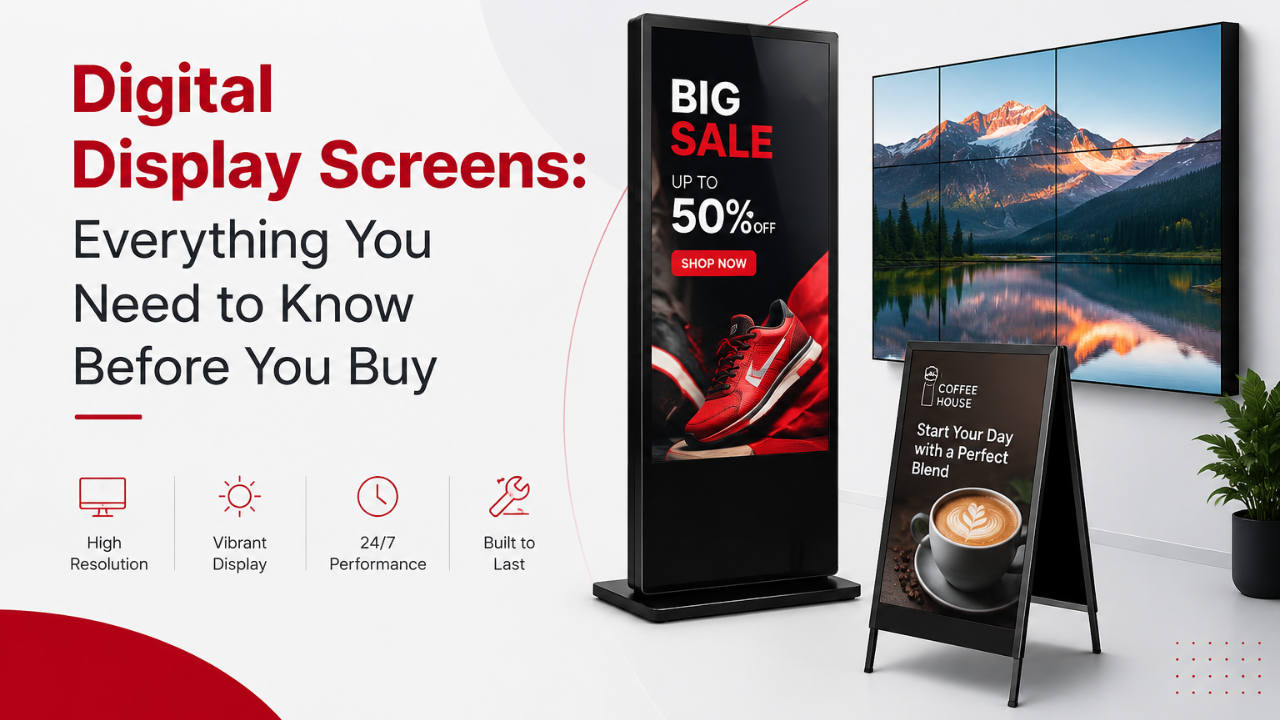
Walk into any modern retail store, hospital, or corporate office in India today and you will find screens everywhere. They show promotions, menus, announcements, queues, and live data. These are digital display screens, and they have quietly replaced almost every printed poster, notice board, and static banner in commercial spaces.
But what exactly is a digital display screen? How does it work? And more importantly, which one should you choose for your business? This guide answers all of that, with no technical jargon.
What Is a Digital Display Screen?
A digital display screen is an electronic device that shows visual content such as images, videos, text, or live data. Unlike a printed poster or a whiteboard, the content on a digital screen can be changed instantly, remotely, and as many times as you like.
Digital displays are used in businesses to communicate with customers, employees, and visitors in real time. A retail store uses them to show daily offers. A hospital uses them to display patient queue numbers. A factory uses them to show live production targets. The common thread is that all these screens get their content from a software platform, not from a printer.
How Does a Digital Display Screen Work?
A digital display system has three main parts working together. Understanding this helps you make a better buying decision.
The Display Screen
This is the physical screen you see on the wall or floor. It can be a commercial TV, an LED panel, a touch-screen monitor, or a slim digital standee. The screen itself does not decide what gets shown on it.
The Media Player
A small device connected to the screen that runs the signage software. This can be an Android box, an Amazon Fire Stick, a Windows mini-PC, or a built-in system-on-chip (SoC) inside the screen itself. The player fetches content and sends it to the display.
The CMS Software
This is the most important part. The Content Management System (CMS) is where you upload your images and videos, schedule what plays when, and manage all your screens from one place. Intelisa is this CMS. You log in from your phone or laptop and your screens anywhere in India update in seconds.
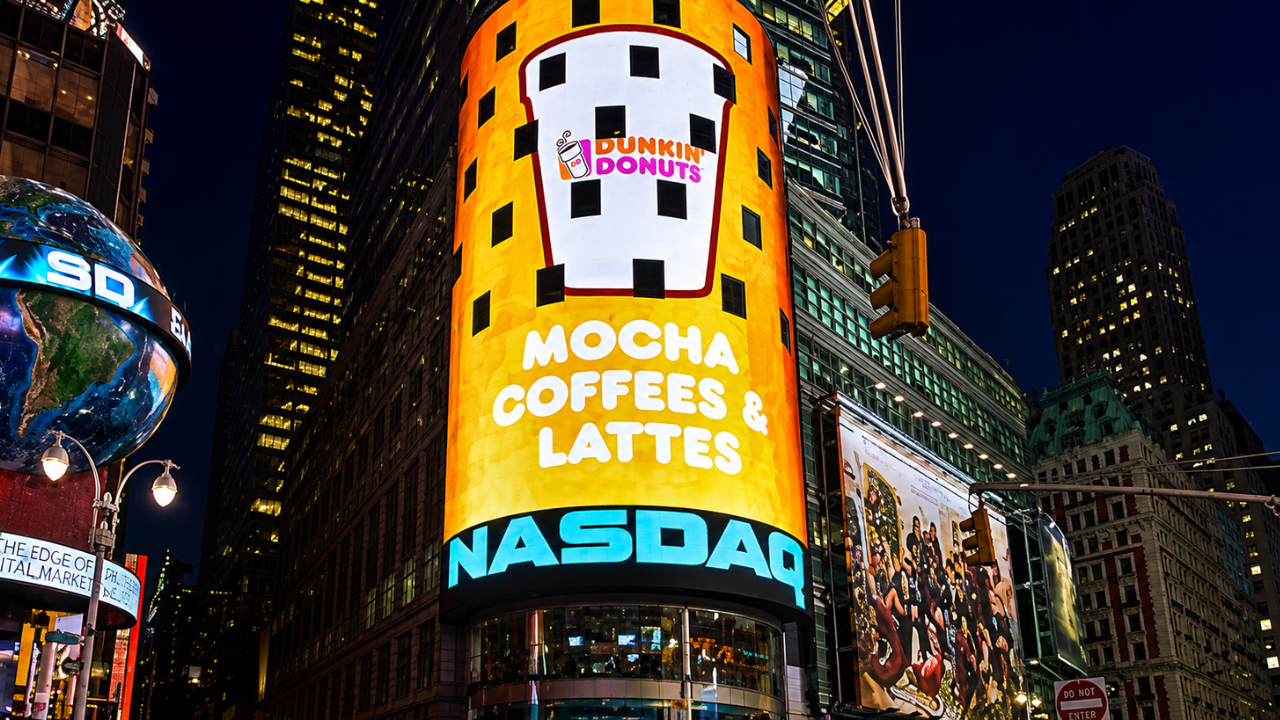
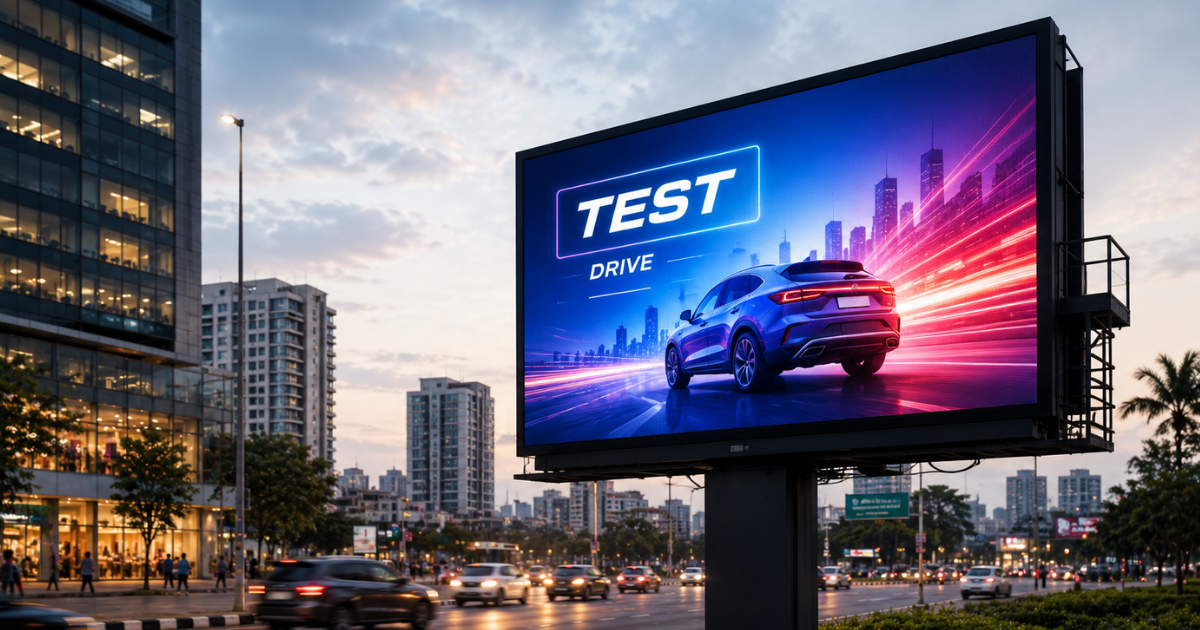
Large outdoor LED screens managed remotely through cloud-based signage software
Types of Digital Display Screens
Not all screens are built the same. Each display technology has different strengths. Here is a breakdown of the most common types used in India today.
LCD Display
LCD (Liquid Crystal Display) screens use a backlight and liquid crystal cells to create an image. They are the most widely used displays in India across offices, retail stores, hospitals, and homes.
Best For: Indoor retail, offices, reception areas, restaurants
LED Display
LED (Light Emitting Diode) screens produce their own light through tiny diodes. They are significantly brighter than LCD screens, making them the go-to choice for outdoor use where sunlight is a challenge.
Best For: Outdoor billboards, DOOH, malls, stadium screens
OLED Display
OLED (Organic LED) screens produce light from each individual pixel, resulting in deeper blacks and more vibrant colors than both LCD and standard LED. They are thinner and consume less power.
Best For: Luxury retail, high-end hospitality, premium lobbies
Transparent Display
Transparent screens show content while still allowing viewers to see through them. This creates a striking visual effect, as if the images are floating in mid-air. Mostly used in premium retail and auto showrooms.
Best For: Jewelry stores, auto showrooms, exhibitions
Touch Display
Touch screens allow users to interact directly with the content. They power self-service kiosks, interactive directories, and digital menus where customers can tap to explore options.
Best For: Kiosks, malls, hospitals, corporate reception
E-Ink Display
E-Ink screens only use power when the image changes, making them extremely energy-efficient. Content looks like printed paper. They cannot play video and are mostly used for price tags or slow-update signage.
Best For: Price tags, library shelves, menu price boards
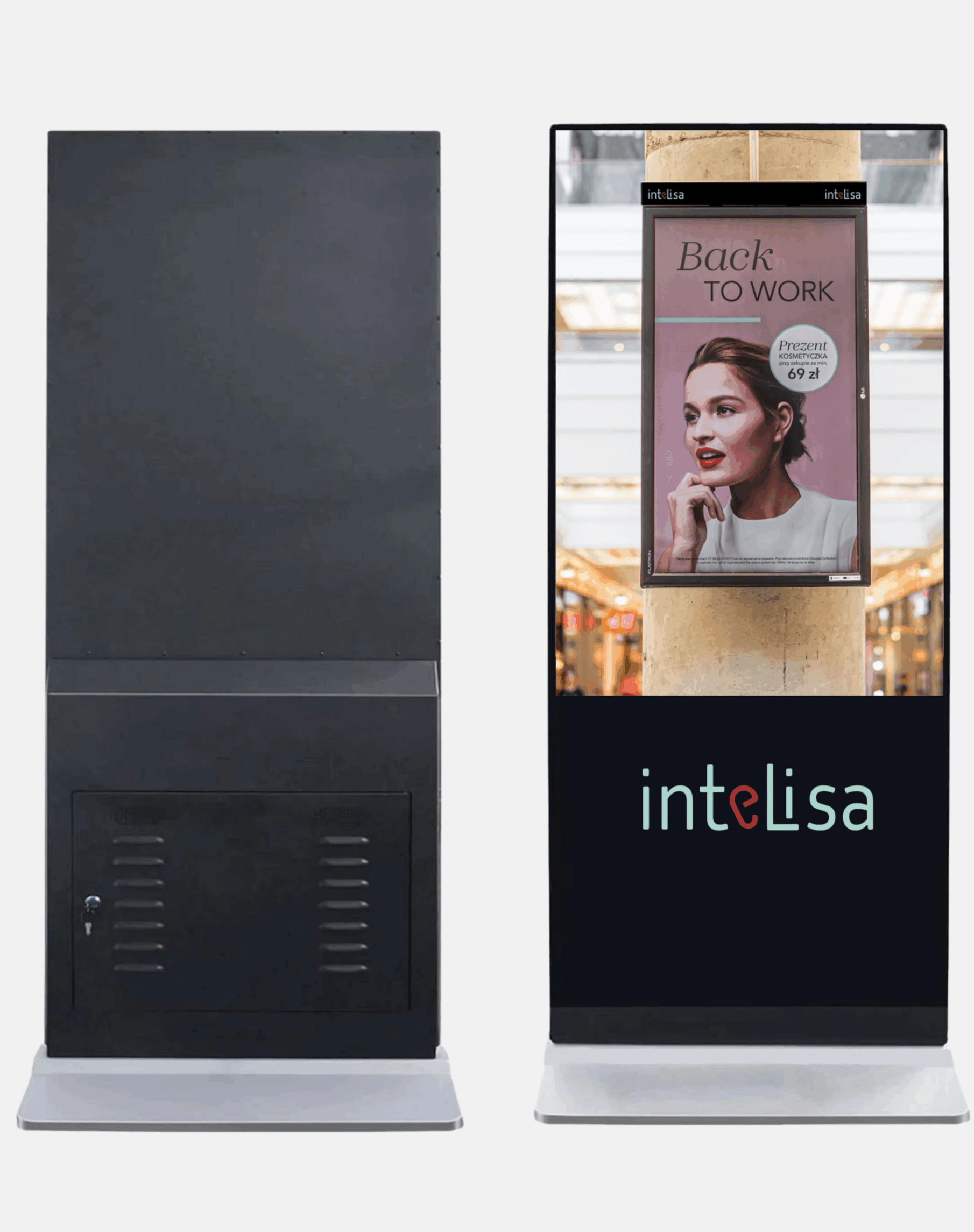
Intelisa Digital Standees
Slim, commercial-grade floor standees with built-in Android, inbuilt speakers, and toughened glass. Ready to connect to Intelisa software out of the box.
- 43" and 55" sizes available
- 400 and 500 Nits brightness
- Full HD and 4K resolution options
- 60,000+ lifetime hours
- Commercial panel for 24x7 operation
- Optional wheels for easy movement
Static Displays vs Digital Display Screens
Most Indian businesses still rely on printed posters, banners, and flex boards. Walk through any market in Mumbai or a mall in Bangalore and you will see hundreds of these. Here is why digital display screens are a better option in almost every situation.
| Factor | Static Printed Signage | Digital Display Screen |
|---|---|---|
| Content Updates | Requires new printing each time | Update in seconds from your phone |
| Number of Messages | Only one message at a time | Rotate multiple messages in a loop |
| Printing Cost | Recurring every time you update | Zero after initial setup |
| Attention Grabbing | Low - people ignore static posters | High - motion and video attract eyes |
| Real-time Information | Not possible | Yes - live prices, queues, data |
| Analytics | No tracking at all | See uptime, playback logs, performance |
| Environment | Paper waste, frequent disposal | Zero paper, long-lasting hardware |
Professional vs Consumer Grade Displays
This is one of the most common mistakes Indian business owners make. They buy a regular consumer TV from an electronics store and use it as a commercial display. Here is why that is a problem.
| Feature | Consumer TV / Home Display | Commercial Display |
|---|---|---|
| Daily Usage Hours | 4 to 8 hours | 16 to 24 hours |
| Brightness | 250 to 350 Nits | 400 to 2500+ Nits |
| Warranty Coverage | Standard home warranty | Commercial grade warranty |
| Orientation Support | Horizontal only | Both portrait and landscape |
| Heat Management | Gets hot with extended use | Built for heat and dust environments |
| Remote Management | Not supported | Fully remote via CMS software |
All Intelisa digital standees and displays are built with commercial-grade panels designed for 24x7 operation. They are made for business use, not home use.
Where Are Digital Display Screens Used in India?
Digital display technology is no longer just for large brands and shopping malls. Today, businesses of all sizes across India are adopting digital displays. Here is how different sectors use them.
Retail and Shopping Malls
Retail stores use digital displays to promote offers, highlight new arrivals, and showcase brand videos near the entrance and billing counter. In shopping malls, large LED screens run paid advertising alongside tenant promotions. Studies show that customers spend more time and money in stores where digital displays are present.
Restaurants and Cafes
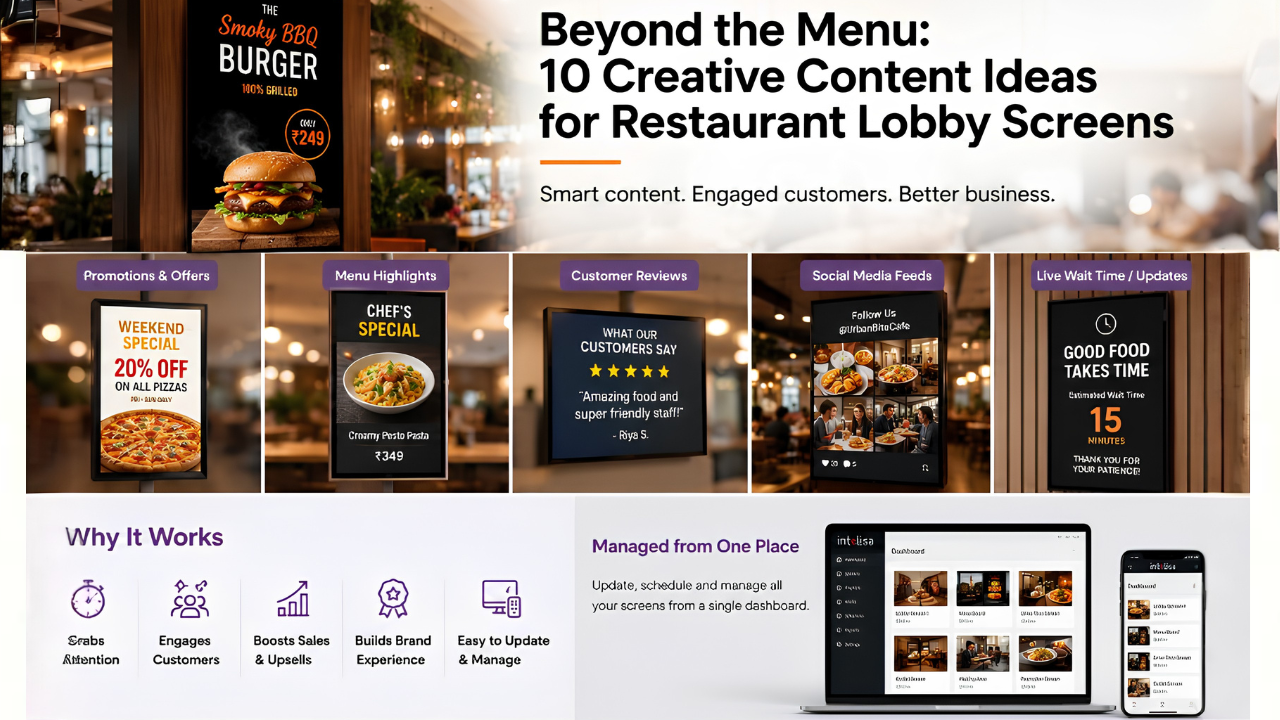
Digital menu boards replace printed laminated menus that get outdated every few months. A restaurant can now update its menu instantly when a dish runs out, change prices without reprinting, or switch from a breakfast menu to a lunch menu automatically at a set time. QSR chains across India have already moved to digital boards completely.
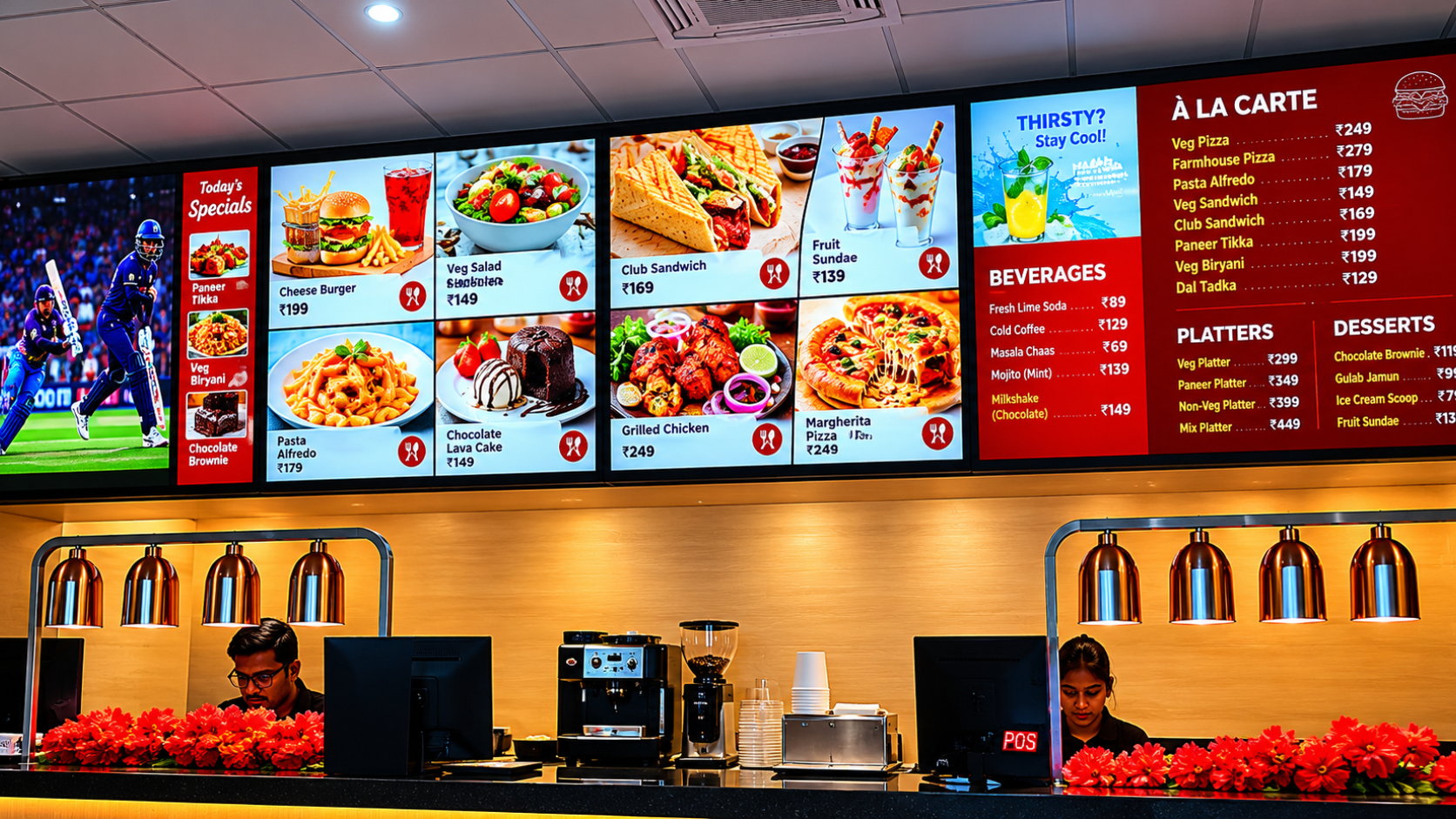
Digital menu boards in Indian restaurants help update offers in real time
Corporate Offices and IT Parks
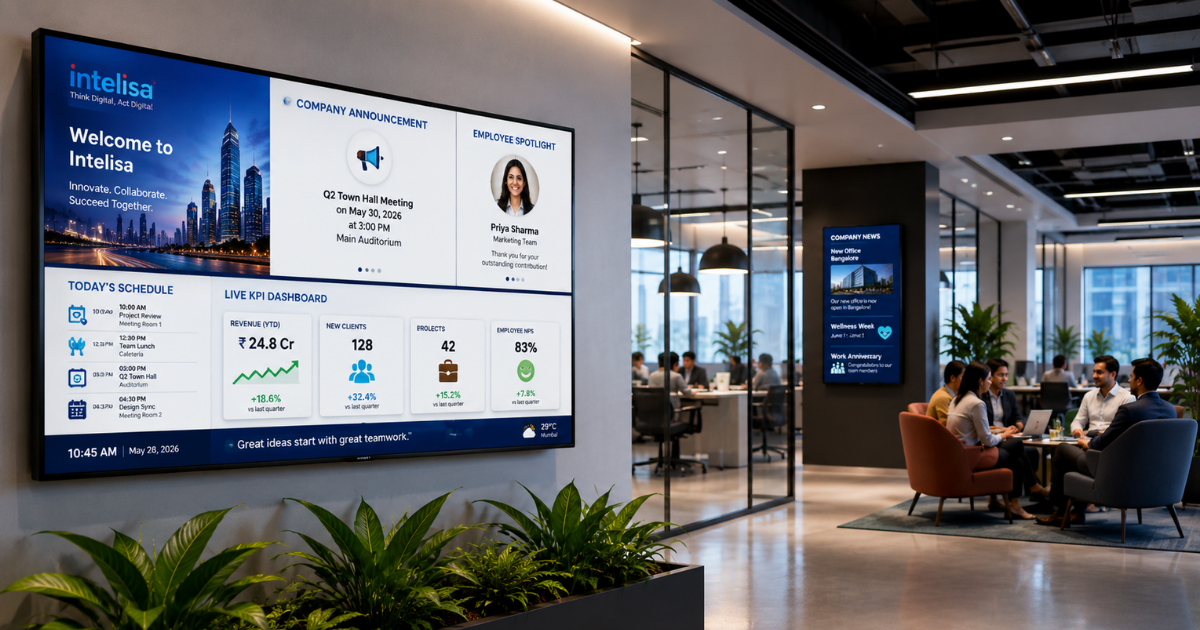
Office screens show company announcements, HR updates, visitor welcome messages, and live dashboards with sales numbers or project status. This replaces the flood of internal emails that nobody reads and makes company communication visible and immediate.
Healthcare and Hospitals
Hospitals in India manage hundreds of patients daily. Digital screens are used to show patient queue tokens, wayfinding directions to departments, health tips in waiting areas, and doctor availability boards. This reduces patient anxiety and staff workload at the same time.
Manufacturing Plants and Warehouses
Factory floors use digital displays to show live production data against targets, safety alerts, shift schedules, and quality control metrics. When a machine breaks down, an alert goes out on all floor screens immediately. This replaces the daily whiteboard update that supervisors would manually do.
Outdoor Advertising and DOOH
Digital Out-of-Home (DOOH) is replacing traditional flex and vinyl billboards across Indian cities. A single digital billboard can run multiple ads from different clients throughout the day, managed from a single software dashboard. No printing, no installation crew, just a content update from a laptop.
Analog vs Digital Displays: What Is the Difference?
The term "analog display" refers to older display technology based on traditional television signals. These screens required thick wiring, could not connect to the internet, and needed a separate video source to show anything. They are mostly obsolete today.
Digital displays use modern panel technologies (LCD, LED, OLED) and connect directly to media players, computers, or cloud-based software. They can receive content over Wi-Fi or a LAN network, be updated remotely from anywhere in the world, and show multiple content formats including video, live data, HTML content, and more. Every commercial screen sold in India today is a digital display.
How to Choose the Right Digital Display Screen for Your Business
The right screen depends on where you are placing it, how bright the environment is, and what kind of content you will display. Here is a simple guide.
| Your Use Case | Recommended Type | Key Spec to Check |
|---|---|---|
| Indoor retail, office, or restaurant | Commercial LCD or LED | 400 to 700 Nits brightness |
| Outdoor billboard or storefront | High-brightness outdoor LED | 2,500+ Nits, IP65 rating |
| Luxury store, hotel, or showroom | OLED or fine-pitch LED | Thin profile, wide viewing angle |
| Self-service kiosk or interactive use | Touch-screen commercial display | Capacitive touch, durable glass |
| Event or exhibition backdrop | LED video wall (modular) | Pixel pitch P2.5 or lower for close viewing |
| Floor standee at entrance or event | Slim digital standee | Commercial panel, 24x7 rated |

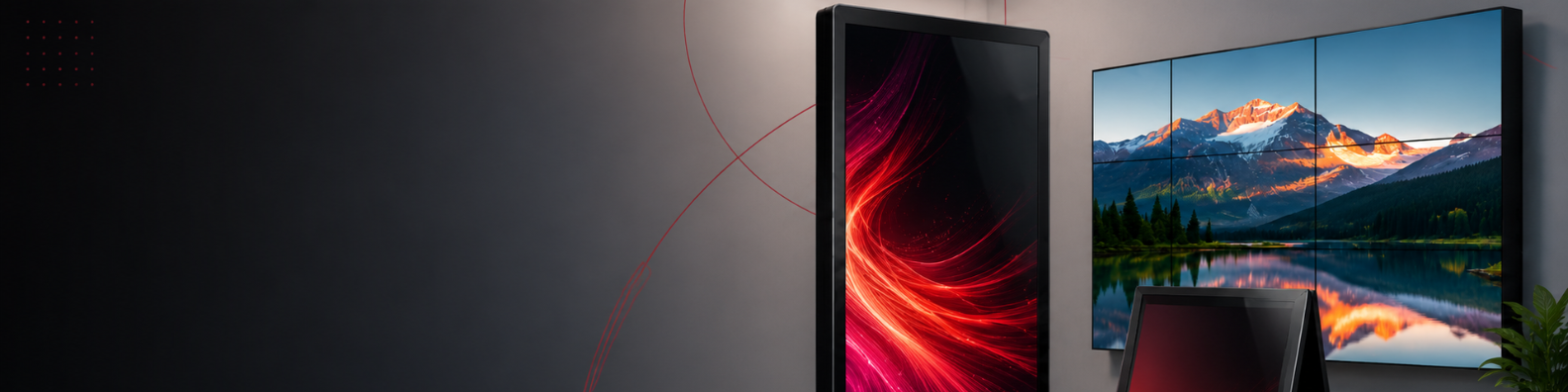
Intelisa custom video wall installations for retail, corporate, and events
Intelisa offers a full range of commercial-grade display hardware including floor standees, wall-mount displays, and custom video walls. All of them connect directly to the Intelisa cloud CMS, so you can manage every screen from one platform regardless of size or location.
Key Advantages of Digital Display Screens for Businesses
Here is a concise summary of why businesses across India are replacing static communication with digital displays.
- Instant content updates - Change what is on your screen in seconds without leaving your desk
- Reduced printing costs - No recurring expenses for banners, flex, and posters
- Better engagement - Moving content and video attract significantly more attention than printed boards
- Multiple messages on one screen - Rotate between offers, news, reminders, and brand content on the same display
- Centralized control - Manage 1 screen or 500 screens from one dashboard
- Real-time data display - Show live stock, queue numbers, sales data, or weather feeds automatically
- Scalable - Start with one screen in your store today and scale to all branches when ready
- Works offline - Screens continue playing cached content even when internet goes down temporarily
What Is a System-on-Chip (SoC) Digital Display?
A System-on-Chip display has the media player built directly inside the screen. This means you do not need a separate device like a Fire Stick or Android box plugged into the screen. Everything runs from within the display itself.
SoC displays are common in commercial Samsung, LG, and Philips screens. They are clean in appearance since there are no extra cables or devices hanging off the screen. Intelisa is compatible with most SoC displays, which means you can manage even built-in media player screens through the same Intelisa dashboard.
Ready to Add Digital Displays to Your Business?
Intelisa makes it easy to get started. Start with one screen and manage it from your phone. No technical setup required. Trusted by Adani, Godrej, and 1,000+ Indian businesses.
Start Your Free 14-Day TrialFrequently Asked Questions
What is a digital display screen?
A digital display screen is an electronic device that shows visual content such as images, videos, text, or live data to an audience. Unlike a printed poster, the content can be updated instantly and remotely using a software platform called a CMS (Content Management System). Digital display screens are used in retail stores, restaurants, hospitals, offices, and outdoor advertising across India.
What are the different types of digital display screens?
The main types of digital display screens are: LCD (Liquid Crystal Display), LED (Light Emitting Diode), OLED (Organic LED), Transparent Display, Interactive Touch Display, and E-Ink Display. Each type has different brightness levels, use cases, and price points. LCD and LED are the most common in Indian businesses. LED is preferred for outdoor use due to its high brightness.
What is the difference between an LED and an LCD digital display?
An LCD screen uses a fluorescent or LED backlight with liquid crystal cells to create an image. What is commonly called an LED TV is technically an LCD screen with LED backlighting. A true LED display uses a panel of individual LED modules as both the light source and the image source. True LED panels are much brighter, more modular, and better suited for outdoor use. LCD screens are more affordable and suitable for indoor commercial use.
How does a digital display screen connect to content?
A digital display screen connects to content through a media player, which can be a separate device (like an Android box or Amazon Fire Stick) or a built-in System-on-Chip (SoC) inside the screen. The media player runs digital signage software that receives content from a cloud-based CMS. You upload your images and videos to the CMS from any browser or phone, and the software pushes the content to your screen over Wi-Fi or a wired network.
What is the difference between a consumer TV and a commercial digital display?
A consumer TV is designed for 4 to 8 hours of use per day in a home environment. A commercial digital display is built for 16 to 24 hours of continuous operation in a business environment. Commercial displays have higher brightness, better heat management, portrait and landscape orientation support, remote management capability, and commercial-grade warranties. Using a consumer TV as a business display leads to early screen failure and poor performance.
What is a digital standee and how is it different from a regular screen?
A digital standee is a slim, freestanding floor display unit that combines a commercial-grade screen with a stylish slim cabinet. Unlike a screen mounted on a wall, a standee can be placed anywhere without any installation. It typically includes an inbuilt Android media player, inbuilt speakers, toughened glass, and optional wheels for easy movement. Intelisa offers 43" and 55" digital standees with Full HD and 4K resolution, rated for 24x7 commercial use.
Can a digital display screen work without the internet?
Yes. Most commercial digital display systems, including Intelisa, support offline mode. This means the screen downloads and caches the content locally. If the internet connection drops, the screen continues playing the last downloaded content without any interruption. An internet connection is required to push new content updates remotely, but it is not required to keep the screen running.
How much does a digital display screen cost in India?
The cost of a digital display screen in India depends on the size, type, and whether it is a standalone screen or a complete solution with a media player and software. A basic 43" commercial screen starts from around Rs. 15,000 to Rs. 25,000. A complete digital standee with built-in Android and commercial panel costs more. Software subscriptions like Intelisa add a small monthly cost per screen. Contact Intelisa for a custom quote based on your specific requirements.
Which industries in India use digital display screens the most?
Digital display screens are widely used across multiple industries in India. Retail stores and shopping malls use them for promotions and branding. Restaurants and QSR chains use digital menu boards. Hospitals and clinics use them for patient queues and wayfinding. Corporate offices use them for employee communication and dashboards. Manufacturing plants use them for KPI boards and safety alerts. Outdoor advertising companies use digital billboards and DOOH screens to run multiple advertising campaigns from one platform.
What software is needed to manage digital display screens?
Digital display screens need a Content Management System (CMS) software to manage what plays on each screen. This software lets you upload images and videos, schedule content by time and day, group screens by location, and monitor screen status remotely. Intelisa is a cloud-based digital signage CMS built specifically for Indian businesses. It works on any screen, supports multiple content formats, and comes with a 14-day free trial. You can manage all your screens from one dashboard on any device.
Ready to Move from Static to Digital?
Digital display screens are no longer just for large corporates with big budgets. Today, a small clothing boutique in Delhi, a pharmacy in Chennai, and a QSR outlet in Pune can all run professional digital signage for a monthly cost that is far less than what they spend on printing alone.
The right screen depends on your environment and use case. But the right software to manage it is the same for everyone. Intelisa gives you a single platform to manage any screen, anywhere, from any device. Start with one screen today and expand as your business grows.
Talk to the Intelisa Team Today
We will recommend the right display type and software plan for your business. No commitment, no pressure.
Visit Intelisa.in